



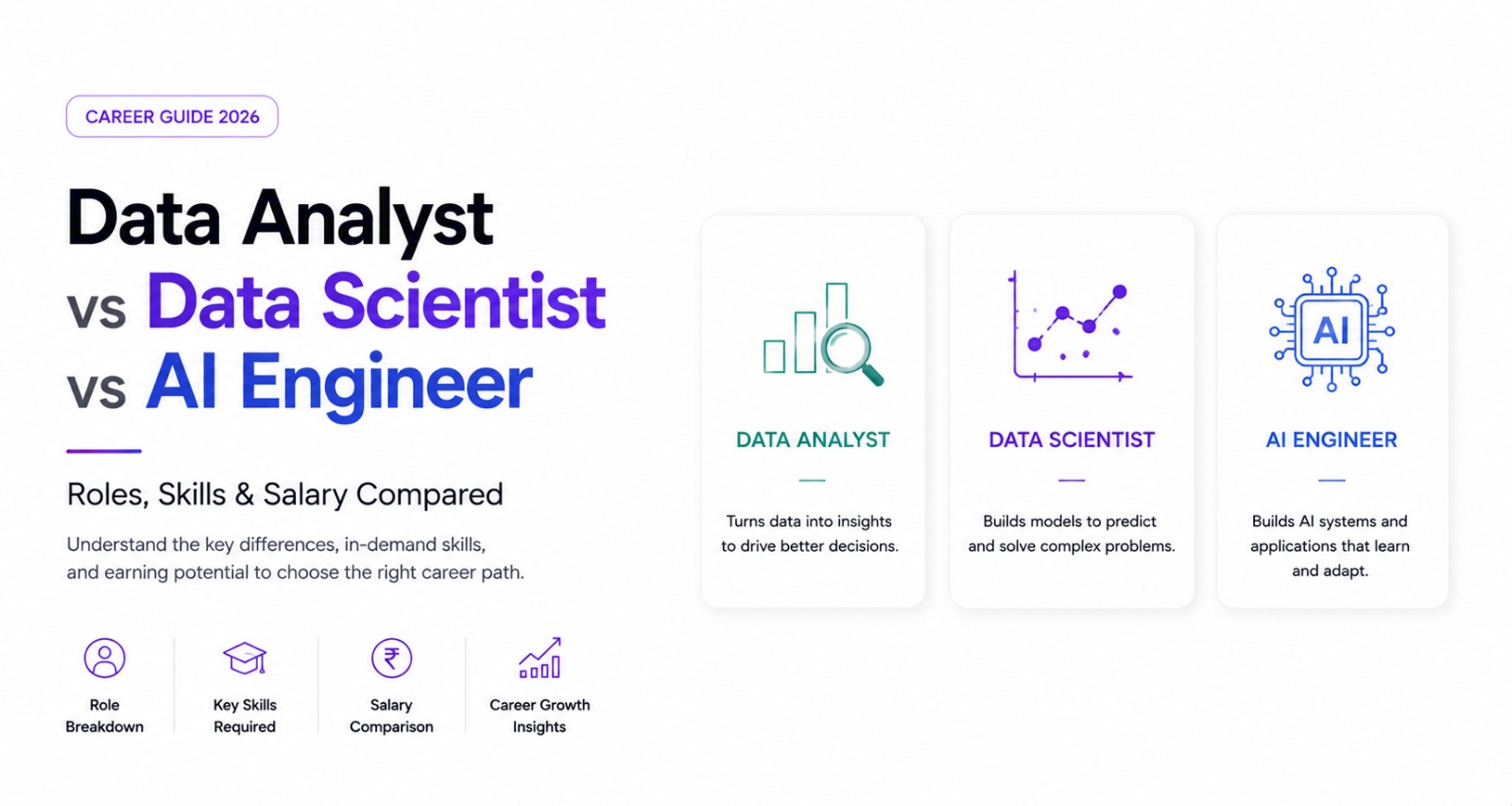
These three job titles get used loosely and interchangeably in casual conversation, but the actual day-to-day work — and the skills required to do each well — differ substantially. Here's the real distinction, role by role.
Data Analyst: Turning Existing Data Into Decisions
A Data Analyst's core job is extracting insight from data that already exists — building dashboards, running SQL queries, identifying trends, and communicating findings to non-technical stakeholders. The emphasis is on description and storytelling, not prediction: explaining what happened and why, clearly enough that a business leader can act on it.
Core skills: SQL, data visualization (Tableau, Power BI), statistical fundamentals, and — often underrated — clear business communication.
Where to build this: Technovalley's Data Analytics Professional program is built specifically around this skill set, with no coding prerequisite.
Data Scientist: Building Predictive and Statistical Models
A Data Scientist goes a step further — using statistical modelling and machine learning to answer what's likely to happen next, not just what already happened. This means feature engineering, model selection, evaluation, and communicating uncertainty, not just clean historical trends.
Core skills: Python, statistics and hypothesis testing, machine learning algorithms, and increasingly, at least conversational fluency with deployment concepts.
Where to build this: Technovalley Certified Data Scientist covers this end-to-end pipeline, culminating in a capstone project — see How Technovalley's Capstone Projects Actually Work.
AI Engineer: Building and Deploying AI Systems in Production
An AI Engineer's work centres on building, deploying, and maintaining AI systems that run in production — increasingly, this means LLM applications, RAG pipelines, and MLOps infrastructure, not just model training. This role sits closest to traditional software engineering of the three, with AI/ML expertise layered on top.
Core skills: Strong programming (Python, often with frameworks like LangChain or PyTorch), cloud infrastructure, deployment and monitoring practices — see our post MLOps Explained: Why Every Data Scientist Needs Deployment Skills.
Where to build this: Technovalley Certified Artificial Intelligence & Machine Learning Expert or, for full-depth specialisation, the One Year Post Graduate Program in Artificial Intelligence Applications.
How Compensation Typically Compares
Broadly, compensation tends to scale with technical depth and deployment responsibility: Data Analyst roles offer the most accessible entry point with solid starting compensation, Data Scientist roles pay a meaningful step above that reflecting the added statistical/ML depth, and AI Engineer roles — particularly those touching MLOps or Generative AI deployment — often command the highest compensation of the three, reflecting current market scarcity. Our post Highest Paying AI Jobs in India 2026 covers this in more depth across a wider set of roles.
Which One Should You Actually Target?
This depends far more on your interests and available learning time than any inherent "better" choice. Our post Which Technovalley AI Program Gives You the Best ROI? can help you map your specific time budget and career stage to the right starting program.
FAQs
Can I move from Data Analyst to Data Scientist to AI Engineer over time? Yes — this is a common, realistic career progression, and many professionals deliberately sequence certifications this way rather than jumping straight to the most advanced role.
Which of these three roles is most in demand right now? Data Analyst roles currently have the highest volume of open positions; AI Engineer roles show the fastest percentage growth, particularly in Generative AI-adjacent hiring.
Do these roles require different degrees? Not strictly — all three are increasingly hired based on demonstrated skill and portfolio (especially a strong capstone project) rather than a specific degree background.
Find the role — and the program — that fits your goals. Explore Technovalley's full program catalogue or talk to our academic team.