



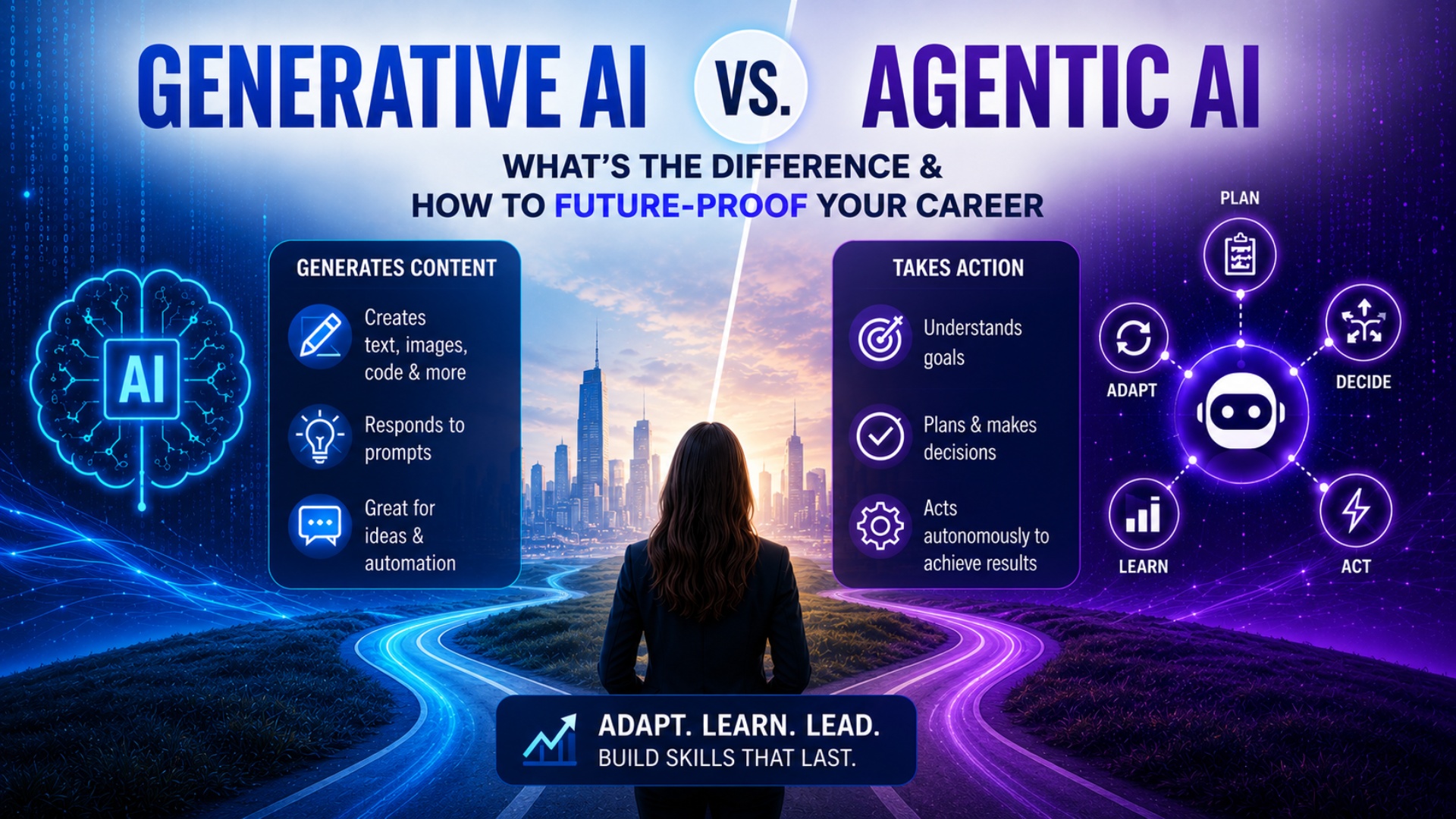
The Core Difference: Content vs. Action
To understand the scope and working of different types of AI, it is important to see how Generative AI and Agentic AI operate.
Generative AI responds to a user prompt and creates content such as text, images, code, audio, or videos. Once the response is generated, the process ends.
Agentic AI focuses on achieving goals. It can create plans, use tools, reason through tasks, and take actions until the objective is completed.
1. Generative AI: The Expert Creator
Generative AI is designed to generate content using Large Language Models (LLMs). It takes a user prompt and produces an output based on patterns learned during training.
How it Works
- Operates on a request-and-response model.
- The user provides a prompt.
- The AI generates content and returns the result.
Limitations
- Has little or no autonomy.
- Cannot independently perform actions outside its environment.
- Requires human input for every new task.
- Cannot automatically chain multiple tasks together.
2. Agentic AI: The Autonomous Worker
Agentic AI is designed to achieve goals rather than simply generate content. Instead of waiting for detailed instructions, it receives a high-level objective and determines the steps needed to complete it.
How it Works
- Receives a goal or objective.
- Creates a plan to achieve the goal.
- Uses available tools, APIs, and applications.
- Can monitor progress and correct mistakes.
- Continues working until the objective is completed.
For example, an Agentic AI system could find broken links on a website, document the issues, create tasks in a project management tool, and verify the fixes without continuous human guidance.
Generative AI vs Agentic AI
| Feature | Generative AI | Agentic AI |
|---|---|---|
| Primary Function | Create content and answer questions | Execute and achieve complex goals |
| User Input | Requires detailed prompts | Requires high-level goals and constraints |
| Autonomy | Low or none | High with self-directed actions |
| Tools Used | Primarily relies on trained knowledge | Uses knowledge, APIs, browsers, databases, and external software |
| Decision Making | Limited to generating responses | Can plan, reason, and take actions |
| Task Execution | One response at a time | Handles multi-step workflows |
| Examples | Writing articles, generating images, answering questions | Managing projects, automating workflows, performing research tasks |