



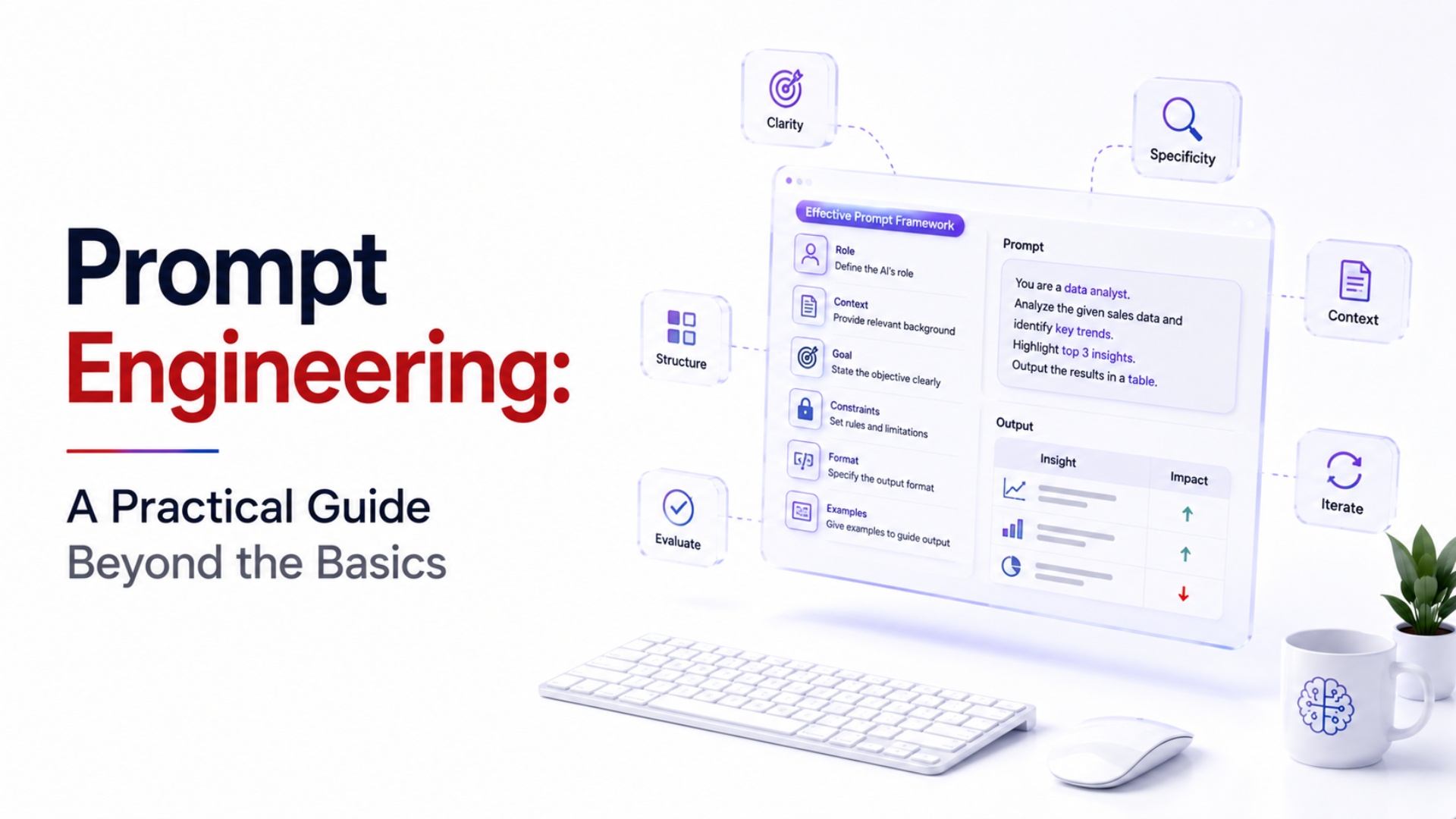
Prompt Engineering: A Practical Guide Beyond the Basics
"Be specific and give examples" is where most prompt engineering advice stops. That's a fine starting point, but it's not what separates someone who gets consistently reliable output from an LLM from someone who's still guessing. Here's what the next level actually looks like.
Why "Just Be Specific" Isn't Enough
LLMs don't fail randomly — they fail in predictable patterns: hallucinating specifics when a prompt is vague, losing instructions buried in a long context, or defaulting to generic output when a task has multiple valid interpretations. Real prompt engineering is about structuring input to close off those specific failure modes, not just writing "nicer" instructions.
Techniques Worth Actually Learning
Few-shot prompting — showing the model 2–3 examples of the input/output pattern you want, rather than describing it abstractly. This consistently outperforms pure instruction-based prompting for tasks with a specific format requirement (structured data extraction, consistent tone matching).
Chain-of-thought prompting — explicitly asking the model to reason step-by-step before answering, rather than jumping straight to a conclusion. This matters most for anything involving multi-step logic, calculation, or judgment calls — and it's a technique Google DeepMind's original chain-of-thought research demonstrated significantly improves accuracy on reasoning-heavy tasks specifically.
Role-based prompting — framing the model's persona ("You are a senior financial analyst reviewing this report for material risks") shapes not just tone but the kind of issues the model prioritises surfacing. This is more than a stylistic trick; it changes what the model treats as relevant.
Constrained output formatting — explicitly specifying output structure (JSON schema, a fixed set of fields, word limits) dramatically reduces the need for post-processing, and is essential once you're building prompts into an actual application rather than a chat interface.
Where This Fits Into an Actual AI Career
Prompt engineering as a standalone skill has a ceiling — it's genuinely useful, but on its own it's not a full career. Where it becomes valuable is as one component of a broader skill set: building RAG pipelines, deploying LLM applications, or evaluating AI system outputs for accuracy and bias. If you're completely new to this, Technovalley's AI Essentials (AI|E) program covers foundational prompt engineering as part of a broader AI literacy curriculum. For learners ready to go further — building prompts into deployed applications with LangChain, vector search, and RAG — the Technovalley Certified Generative AI Expert (GAIE) program is the natural next step, and our post What Is RAG? A Complete Beginner's Guide covers exactly how prompting fits into that larger system.
FAQs
Is prompt engineering still a relevant skill as models improve? Yes, though its nature is shifting — as models get better at inferring intent, the highest-value prompting skill is increasingly about structuring multi-step, tool-using workflows rather than single clever prompts.
Do I need to know Python to learn prompt engineering? No — core prompting technique can be learned and practiced directly through a chat interface. Python becomes relevant once you're building prompts into an application.
What's the difference between prompt engineering and fine-tuning? Prompt engineering shapes model behaviour through input alone, with no changes to the model itself. Fine-tuning actually retrains the model on your specific data — a deeper, more resource-intensive intervention typically reserved for specialised, high-volume use cases.
Ready to build real skill beyond chat-window prompting? Explore Technovalley's Generative AI programs or talk to our academic team.