



How Technovalley's Capstone Projects Actually Work (With a Real Example)
Every Technovalley program page mentions a "capstone project," but that phrase gets used loosely across the training industry — sometimes it means a genuine, mentored, end-to-end project; sometimes it means a two-hour exercise dressed up with a bigger name. Here's exactly what it means at Technovalley.
What a Capstone Project Actually Involves
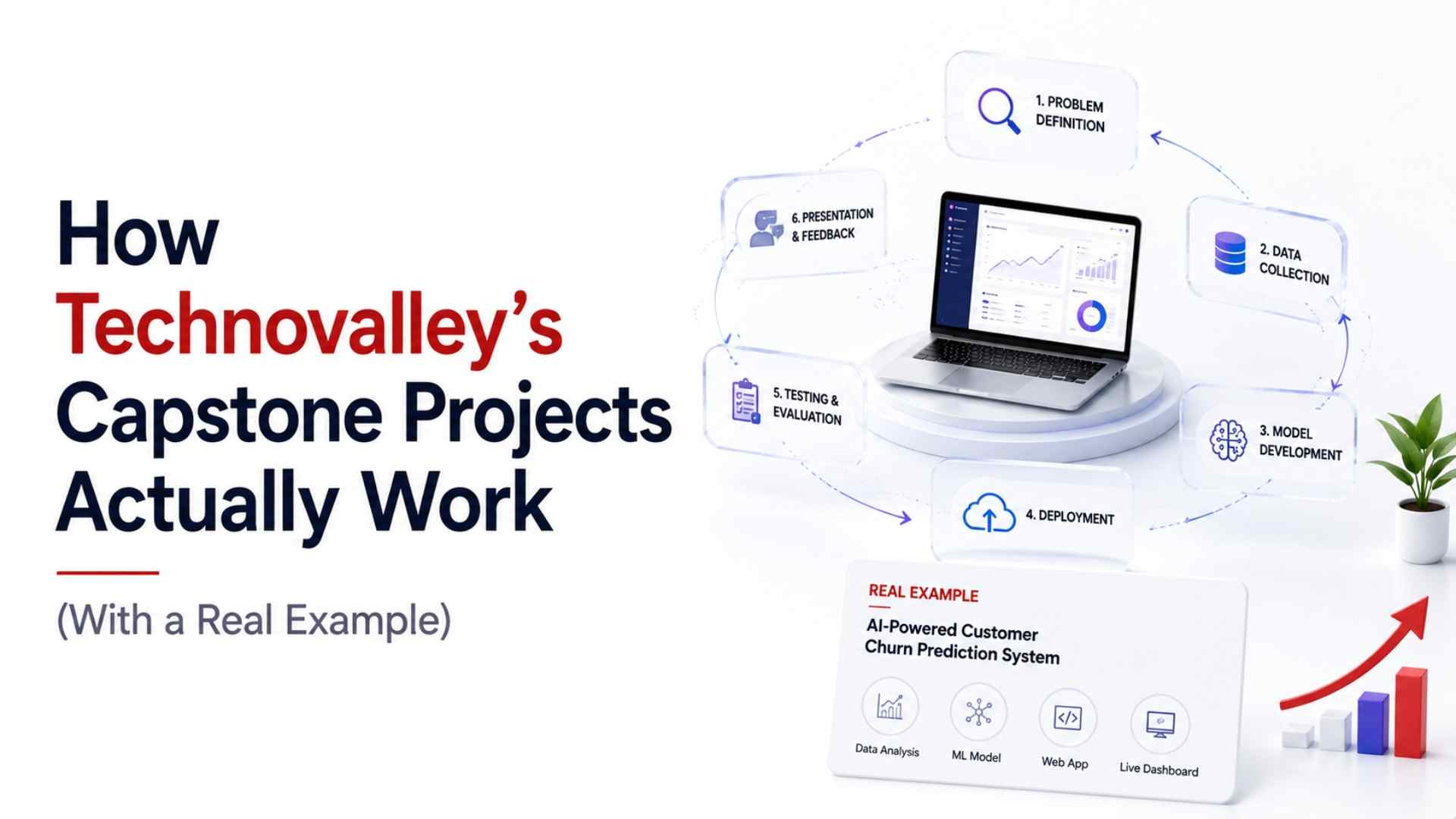
Across programs like the Technovalley Certified Data Scientist and Technovalley Certified Data Analytics Professional certifications, the capstone isn't a bolt-on final assignment — it's built into the curriculum structure from the start, using Technovalley's proprietary AKS (Advanced Knowledge Services) framework. The structure typically follows four stages:
Problem definition — you're given (or choose, with mentor guidance) a real-world business problem, not a toy dataset stripped of context
Data work — cleaning, feature engineering, and exploratory analysis on data that reflects the messiness of real business data, not a pre-cleaned Kaggle set
Modelling or analysis — applying the specific techniques from your program (statistical modelling, ML algorithms, or BI dashboarding depending on the track)
Delivery and defence — presenting the finished work as you would to a real stakeholder, with 1-on-1 mentor feedback throughout, not just at the end
A Representative Example
A typical Data Analytics Professional capstone might look like: taking a retail company's raw, messy sales transaction data, cleaning and structuring it with SQL, building an interactive Tableau or Power BI dashboard that surfaces actionable insight (say, regional sales decline patterns), and presenting findings the way you would to a non-technical business stakeholder — the storytelling layer, not just the chart. A Data Scientist track capstone follows a similar arc but ends in a predictive model with documented evaluation metrics and a written explanation of tradeoffs, rather than a dashboard.
For the one-year postgraduate programs — like the One Year Post Graduate Program in Artificial Intelligence Applications — this happens at the end of each semester, not just once at the very end, meaning learners build and defend three distinct project-based evaluations across the year rather than a single capstone.
Why This Structure Matters for Your Job Search
Harvard Business Review's coverage of data science hiring has repeatedly pointed to the same gap: employers consistently struggle to differentiate candidates who "know the algorithms" from candidates who can actually deliver a business-ready data product end to end. A completed, defensible capstone project is the single most concrete piece of evidence you can put in front of an interviewer that closes that exact gap — it's not a certificate claim, it's a work sample.
This is also precisely why our placement guidance consistently tells learners: the capstone isn't optional polish, it's the centrepiece of your portfolio. Our companion post, From Certification to First Job: Technovalley's Placement Process, Week by Week, walks through exactly how the capstone gets used during interview preparation.
FAQs
Do I choose my own capstone project topic? Often yes, within guardrails set by your mentor to ensure the scope matches your program's skill level and timeline.
Is the capstone graded, or just completed? It's evaluated with structured feedback from your mentor — the goal is a portfolio-ready result, not a pass/fail checkbox.
Can I use my capstone project in job interviews? Yes — this is explicitly the intent. Learners are encouraged to present capstone work directly in technical interviews as evidence of applied skill.
See what a capstone project could look like for your specific goals. Explore Technovalley's AI and data science programs or talk to our academic team.