



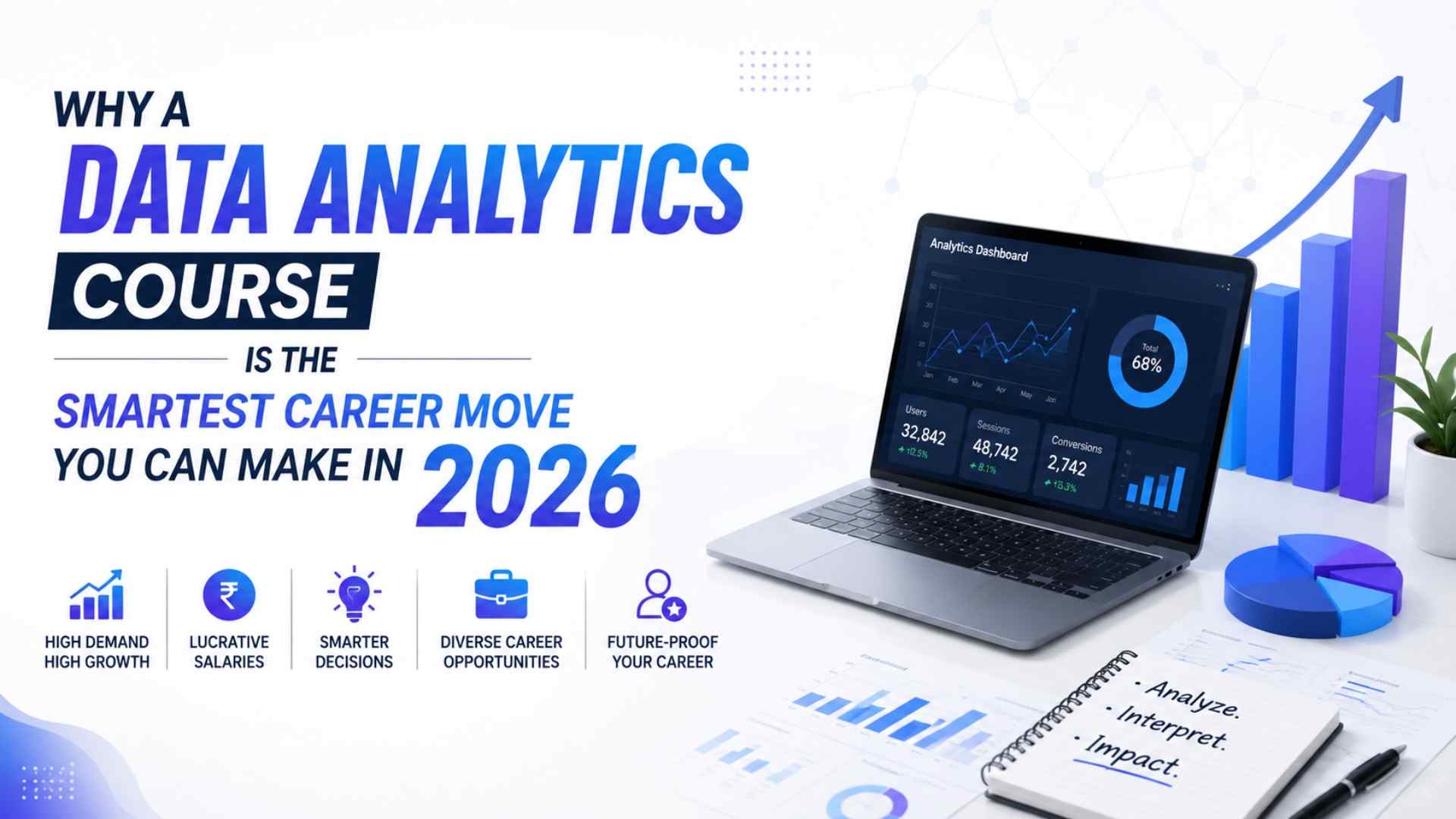
Every business decision today — from what a retailer stocks on its shelves to how a hospital schedules its staff — starts with data. But raw data on its own is just noise. The people who can turn that noise into a clear business decision are some of the most valuable (and most hired) professionals in the world right now. That's exactly why a data analytics course has become one of the fastest, most practical routes into a stable, well-paying tech career — no coding background required.
If you've been on the fence about whether this is the right time to upskill, here's what the data itself says, and how to choose a program that actually gets you hired.
The Demand for Data Analysts Isn't Slowing Down
Organizations across finance, healthcare, retail, and technology are all racing to become more data-driven, and that means the hiring pipeline for analysts keeps growing. According to the U.S. Bureau of Labor Statistics, employment in data-related occupations is projected to grow much faster than the average for all occupations over the next decade, driven by the sheer volume of data organizations now collect and their need to make sense of it.
This demand isn't limited to Silicon Valley or global tech hubs. Companies in Kerala, across India, and internationally are actively building in-house analytics teams, which means locally trained, certified analysts are in a strong position to compete for both domestic and global roles.
What Does a Data Analyst Actually Do?
A common misconception is that data analytics is only for engineers or statisticians. In reality, a data analyst's day-to-day work is closer to detective work than pure coding:
Extracting and organizing data from databases using SQL
Cleaning messy datasets so they're accurate and usable
Building dashboards and visual reports using tools like Tableau and Microsoft Power BI
Applying statistical methods to spot trends, patterns, and outliers
Communicating findings to stakeholders who may not have a technical background
It's this mix of technical skill and business storytelling that makes analysts so valuable — and so hard to automate away entirely, even as AI tools take over more of the repetitive grunt work.
Skills Employers Are Actually Looking For in 2026
If you're evaluating a data analytics course, make sure the curriculum goes beyond theory and covers the tools employers are actively hiring for:
SQL — still the backbone of how companies query and manage data
Data cleaning and preparation — because messy, inconsistent data breaks every analysis downstream
Data visualization and storytelling — using Tableau or Power BI to turn numbers into a narrative
Statistical foundations — understanding distributions, correlation, and significance before drawing conclusions
Predictive modeling basics — regression, classification, and clustering to move from "what happened" to "what's likely to happen next"
Business context — the ability to tie an analysis back to revenue, cost, or customer impact
A program that only teaches one or two of these leaves gaps that show up in interviews. Employers today expect end-to-end analytics thinking, not just spreadsheet skills.
Why Certification Still Matters
With so many free tutorials online, it's fair to ask whether a formal certification is worth it. Three things a structured program gives you that self-study rarely does:
A verified credential recruiters can trust, especially when you're switching careers or industries
Mentorship and feedback from people who've actually worked as analysts, so you're not just guessing whether your project is "good enough"
A capstone project and portfolio built on real datasets, which is what hiring managers actually want to see — not just a certificate, but proof you can do the job
This is precisely the gap the Technovalley Certified Data Analytics Professional program is built to close. It's a 150-hour, industry-linked curriculum covering SQL, data cleaning, Tableau, Power BI, and predictive modeling, with hands-on labs, a capstone project, and 100% placement support — including resume building, interview preparation, and direct connections to hiring partners like Deloitte, Accenture, IBM, and TCS.
Who Should Take a Data Analytics Course?
You don't need a computer science degree to start. This path works well for:
Working professionals in non-technical roles who want to move into a data-driven function
Career switchers from finance, operations, marketing, or customer support
Fresh graduates looking for a practical, job-ready skill set beyond their degree
Entrepreneurs and freelancers who want to make smarter, data-backed decisions in their own business
Most programs, including Technovalley's, start from the fundamentals and build up gradually, so no prior programming experience is required.
Salary and Career Growth Potential
Compensation for data analysts varies by region and experience, but the trend is consistently upward. In India, certified analysts typically move into roles paying anywhere from ₹8 to ₹25 LPA depending on experience and specialization, while in markets like the US, UK, and Australia, analytics salaries regularly cross six figures for mid-to-senior professionals. Roles to target after certification include Data Analyst, Business Intelligence Analyst, Insights Consultant, and Predictive Modeling Specialist.
How to Choose the Right Program
Before enrolling in any data analytics course, check for:
Curriculum depth — does it cover SQL, cleaning, visualization, and modeling, or just one of these?
Hands-on projects — real datasets and a capstone project, not just video lectures
Placement support — resume help, mock interviews, and recruiter connections
Industry recognition — partnerships with established global certifying bodies
Flexible delivery — weekday/weekend and online/hybrid options if you're working full-time
Technovalley has trained over 20,000 learners since 2016 and holds ISO 9001:2015 certification, with strategic alliances across global certifying authorities including Microsoft, Oracle, CompTIA, and EC-Council. You can read more about the organization's background on the About Us page, or browse more career and industry insights on the Technovalley Blog.
Final Thoughts
Data isn't going away — if anything, every industry is generating more of it every year, and someone has to make sense of it. A well-structured data analytics course gives you the technical skills, the portfolio, and the credential to step into that role with confidence, whether you're starting fresh or pivoting your career entirely.
If you're ready to take the next step, explore the Technovalley Certified Data Analytics Professional program or get in touch with the admissions team to discuss which learning format fits your schedule.