



Almost every resume claims some form of AI fluency now. That's the problem. When everyone lists "AI skills" in their skills section, the phrase stops meaning anything — and recruiters have caught on.
In 2026, the resumes that actually get shortlisted aren't the ones that mention AI the most. They're the ones that prove a specific, verifiable AI capability tied to a measurable outcome. This guide breaks down exactly what recruiters and hiring systems are screening for this year, why the generic "AI-aware" resume is losing ground, and how to close the gap with the right depth of skill in the right domain.
The AI Resume Has Changed — Fast
A few hiring cycles ago, simply naming ChatGPT or "machine learning" on a resume was enough to signal you were current. That's no longer true. Recruiting teams report that a large majority of resumes now mention some form of AI familiarity, which means the claim itself carries almost no differentiating value anymore.
What changed the game is twofold:
Recruiters got smarter tools. Modern applicant tracking systems don't just keyword-match anymore — they evaluate context, consistency, and demonstrated depth, not just whether a term appears on the page.
Recruiters got more skeptical of polish. A large share of hiring managers now say they can spot an AI-generated, generic resume almost immediately, which means unsupported claims are actively working against candidates rather than for them.
The net effect: vague AI familiarity reads as a red flag, not a strength.
What Recruiters Are Actually Scanning For
Across current hiring research, a few consistent signals separate resumes that get shortlisted from resumes that get filtered out:
Domain-specific depth over generalist claims. The majority of current AI job listings are seeking candidates with focused, specialized expertise rather than broad, surface-level AI knowledge.
Evidence, not adjectives. Recruiters want a bullet that shows how AI was used to produce a specific result — a shortened cycle time, a reduced error rate, an automated workflow — not a line that simply states "AI-savvy."
Keyword alignment with the actual job description. Because many job postings are now AI-drafted and densely structured, resumes need to mirror the specific phrasing of the role, not a generic version of the skill.
Certifiable, third-party-verified skills. With degree requirements dropping at a large share of major employers, a recognized certification is increasingly what allows a resume to pass a skills-based screen without a traditional credential attached.
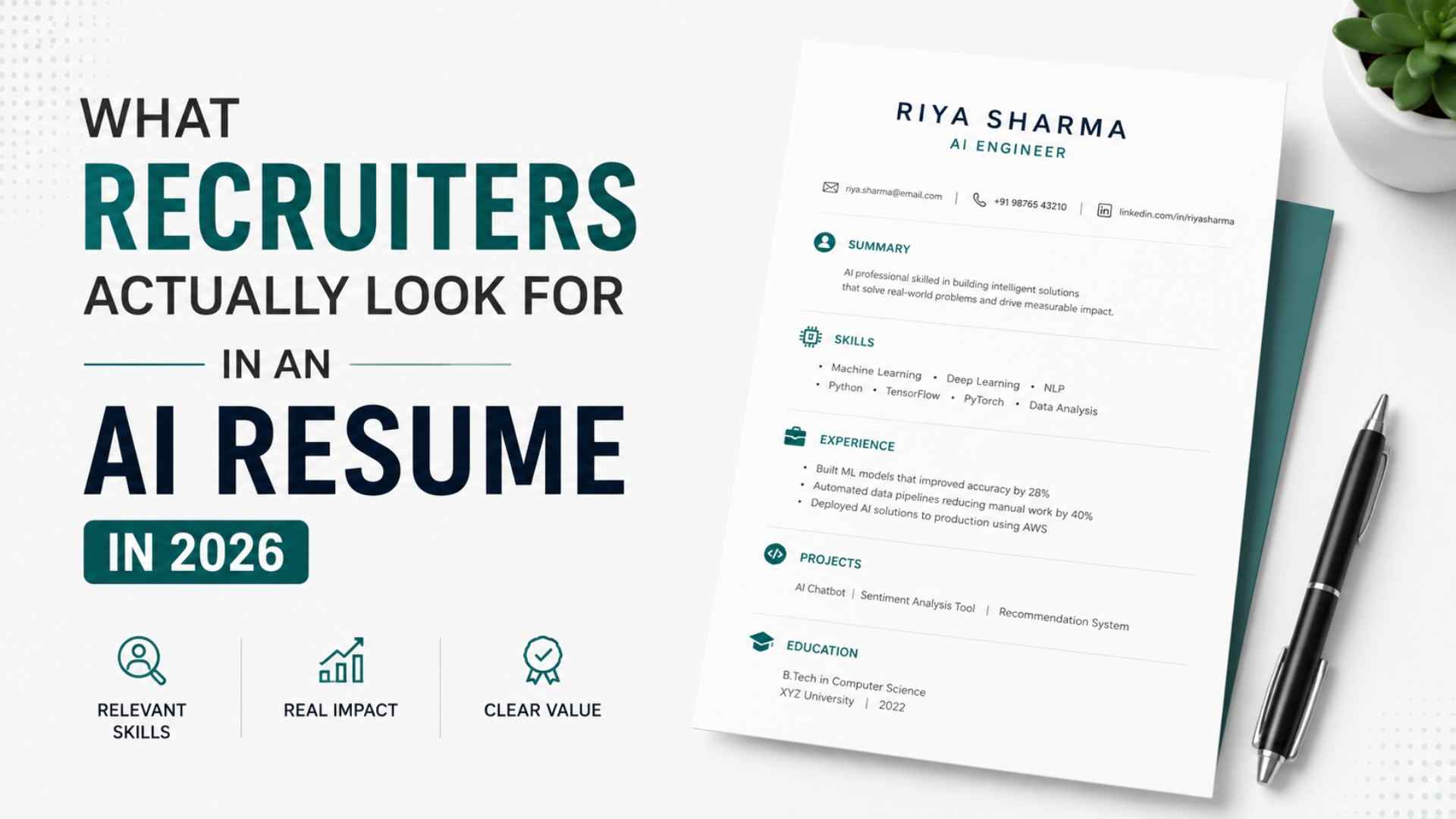
A clean, ATS-friendly structure. Standard section headers, a dedicated skills section, and no multi-column layouts that confuse automated parsers.
In short: recruiters aren't asking "do you know AI?" anymore. They're asking "which part of AI do you actually own, and can you prove it?"
The Real Gap: Candidates List AI, Employers Need a Specific AI Skill
This is the core mismatch driving rejections in 2026. Job seekers tend to treat "AI skills" as one category. Employers treat it as at least six distinct hiring lanes, each requiring different depth:
1. Baseline AI Literacy (the new minimum, not a differentiator)
Every role — technical or not — is now expected to show basic comfort with AI tools, prompt engineering, and responsible AI use. This is table stakes, not a specialization. A structured foundation like the Artificial Intelligence Essentials (AI|E) program covers exactly this layer — AI fundamentals, prompt engineering, and responsible AI practices — and is a reasonable starting credential for non-technical professionals who need to stop being screened out for lacking any verifiable AI exposure.
2. Core Machine Learning & AI Engineering Depth
For technical roles, recruiters are looking past "I used AI" toward actual model-building, data pipeline, and deployment skill. Programs like the Technovalley Certified Artificial Intelligence & Machine Learning Expert or the One Year Post Graduate Program in Artificial Intelligence Applications are built for candidates who need to show applied ML depth, not just tool familiarity.
3. Generative AI Specialization
Generic "I use ChatGPT" claims no longer register. Recruiters hiring for GenAI-adjacent roles want to see LLM application skills, retrieval-augmented generation, and enterprise GenAI deployment experience. The Technovalley Certified Generative AI Expert (GAIE), OCI Generative AI Professional, and the One Year Post Graduate Program in Generative AI Applications all target this exact specialization gap.
4. Data Science & Analytics Fluency
Employers still overwhelmingly want candidates who can turn AI outputs into business insight — not just generate content, but analyze, model, and interpret data. This lane is covered by programs like the Technovalley Certified Data Scientist, Technovalley Certified Data Analytics Professional, Oracle Data Science Professional, and the One Year Post Graduate Program in Data Science and Machine Learning.
5. Agentic AI (the fastest-growing, least-supplied skill)
As organizations move from single-prompt AI tools to autonomous multi-step agents, very few candidates can demonstrate real experience building or managing agentic systems. This is currently one of the widest supply gaps in the market. The One Year Post Graduate Program in Agentic Artificial Intelligence is built specifically for this emerging lane.
6. AI Governance, Program Management & Risk
Beyond the technical roles, organizations increasingly need people who can turn AI initiatives into measurable business outcomes — managing rollout, ROI, and responsible-AI compliance. This is a leadership-track lane rather than a technical one, covered by the Certified AI Program Manager (C|AIPM).
7. AI Security (the newest hiring lane)
As AI systems handle more sensitive data and autonomous decision-making, security has become a baseline expectation across nearly every role, not just security teams. On the specialist side, this is exactly the gap covered by the Certified Offensive AI Security Professional (C|OASP) — red-teaming LLMs, adversarial ML, and AI infrastructure security. We covered this specialization in more depth in our beginner's guide to AI red teaming.
8. Cloud AI Foundations
For candidates targeting enterprise environments running on major cloud platforms, a foundational cloud-AI credential signals platform-specific readiness. The OCI AI Foundations Associate program is a common entry point here.
How to Present This on Your Resume
Once you've picked your lane, the presentation matters as much as the skill itself:
Give AI its own skills section. Don't bury it inside a generic "Skills" list — a dedicated, scannable AI section signals seriousness.
Pair every skill with an outcome. Use a structure like Situation → Obstacle → Action → Result instead of a bare skill list. "Used prompt engineering to cut content review time by 40%" beats "prompt engineering" on its own every time.
Mirror the job descriptions exact language. If a posting says "LLM evaluation," don't write "AI testing" — match the term.
Back every claim with a credential or project. A certification, portfolio link, or specific deliverable turns a claim into evidence an ATS and a human can both verify.
Keep formatting parser-friendly. Standard headers, no heavy graphics or multi-column layouts, and a clean chronological or hybrid structure.
The Employer-Side Takeaway
For hiring teams, the same gap runs in reverse: most candidate pools are saturated with generic AI claims and thin on verified, lane-specific depth — especially in agentic AI and AI security, two of the fastest-growing and most under-supplied specializations right now. Recognizing which lane a role actually needs, rather than screening for the word "AI" itself, is what separates hiring teams that fill specialized roles quickly from the ones stuck sorting through hundreds of interchangeable resumes.
Final Thoughts
The AI resume conversation has moved past whether you know AI — everyone claims that now. What actually gets you shortlisted in 2026 is proof of a specific, in-demand AI lane, presented with measurable outcomes and backed by a credential that a recruiter or ATS can verify at a glance. Whether that lane is generative AI, data science, agentic systems, AI governance, or AI security, the candidates closing the gap are the ones building verifiable depth in one area — not spreading themselves thin across a buzzword list.