



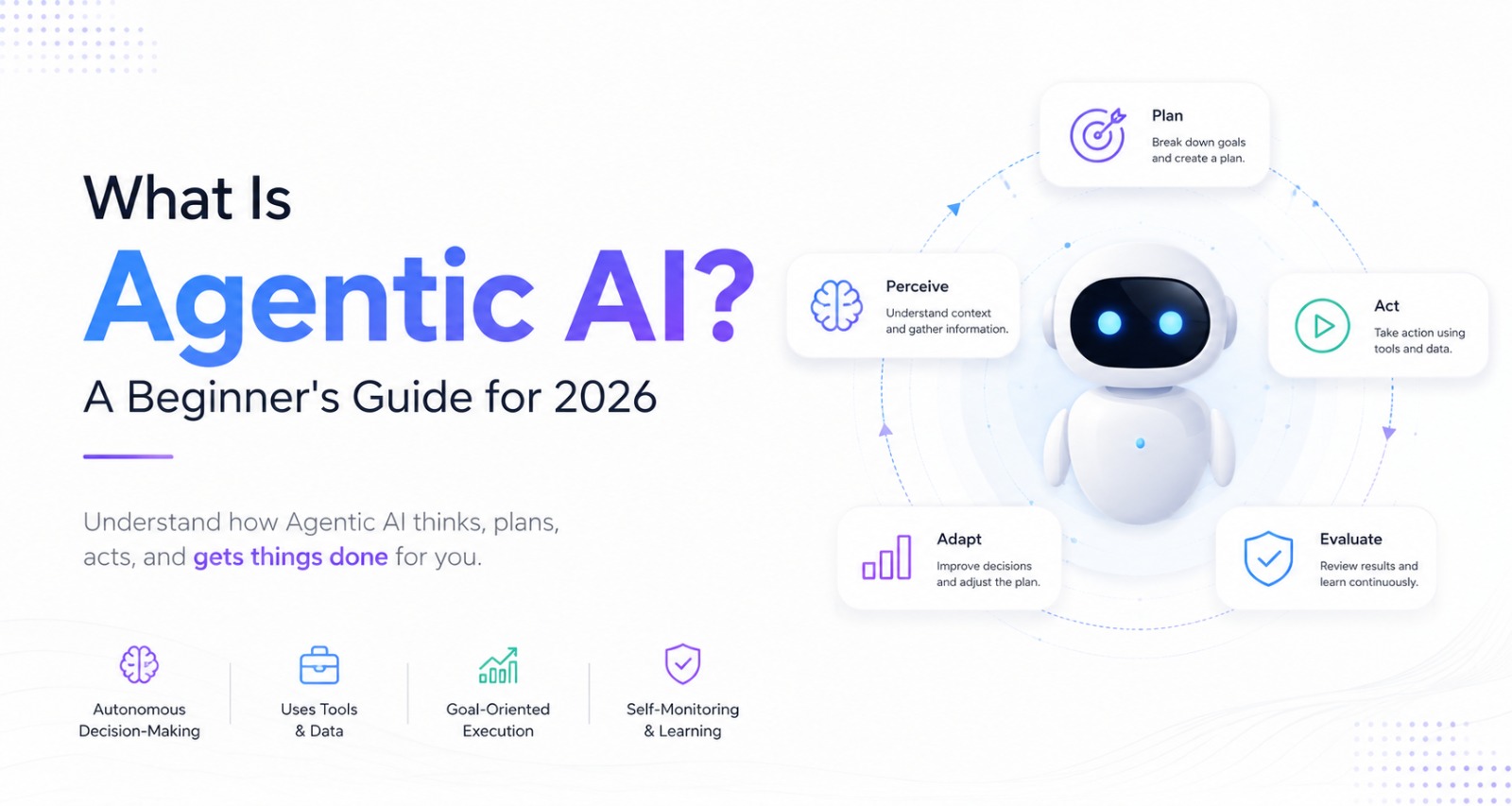
The Core Idea, in Plain English
A regular AI chatbot is reactive. You give it a prompt, it generates a response, and the interaction ends — even if the task needed five more steps, it stops and waits for you to ask again. An AI agent is different because it's built to pursue a goal, not just answer a question.
Give a generative AI tool the instruction "book me a flight to Delhi next Tuesday," and it can draft an email or suggest options. Give an agentic AI system the same instruction, and it can search flight options, compare prices across sites, check your calendar for conflicts, fill out the booking form, and confirm the reservation — asking you for input only where it genuinely needs a decision from you.
The shift is from generating content to completing tasks.
What Actually Makes a System "Agentic"
Not every AI tool that takes an action qualifies as agentic. A few things need to be true:
Planning — the system breaks a goal into a sequence of steps on its own, rather than following a fixed script.
Tool use — it can call external tools: search the web, query a database, run code, use an API, or trigger another application.
Memory — it retains context across steps of a task (and sometimes across sessions), so it doesn't lose track of what it already did.
Iteration and self-correction — it can check whether a step actually worked, and adjust its plan if it didn't, instead of blindly continuing.
Autonomy within limits — it acts without a human approving every single step, though well-designed systems still include checkpoints for anything high-stakes or irreversible.
A basic chatbot with a search plugin isn't automatically "agentic" — the label depends on whether the system is actually planning and iterating toward a goal, not just answering a single query with an extra data source.
Single Agents vs Multi-Agent Systems
Most real agentic AI deployments in 2026 fall into one of two patterns:
A single agent handles one goal end-to-end — for example, an agent that monitors your inbox, drafts replies to routine emails, and flags anything that needs your judgment.
A multi-agent system splits a larger goal across several specialised agents that coordinate with each other. One agent might research a topic, another draft content based on that research, and a third review it against a style guide before anything reaches a human. Frameworks like LangChain, CrewAI, and AutoGen exist specifically to orchestrate this kind of hand-off between agents.
Multi-agent setups tend to show up in enterprise automation — customer support triage, supply chain monitoring, compliance checks — where a task naturally breaks into distinct roles.
Where Agentic AI Is Actually Being Used
The practical use cases in 2026 are less flashy than the sci-fi framing suggests, but genuinely useful:
Customer support — agents that resolve routine tickets end-to-end and escalate only the ones that need a human.
Software development — coding agents that can read an issue, write a fix, run tests, and open a pull request, with a developer reviewing before merge.
Research and reporting — agents that pull data from multiple sources, cross-check it, and compile a structured report instead of a single-source summary.
Business process automation — agents that handle multi-step admin work like onboarding, invoice processing, or scheduling across systems that don't otherwise talk to each other.
Agentic AI vs Generative AI: The Difference That Actually Matters
It's worth being precise here, since the two terms get used interchangeably. Generative AI is about producing content — text, images, code — from a prompt. Agentic AI is about pursuing a goal, which often uses generative AI as one component (to draft text, summarise a document, or write code) but wraps it in planning, memory, and tool use that a plain generative model doesn't have on its own. Our earlier post, Generative AI vs. Agentic AI: What's the Difference & How to Future-Proof Your Caree, goes deeper into this distinction if you want the fuller picture.
The Risks Worth Knowing Before You Build or Deploy One
Autonomy cuts both ways. An agent that can act without approval on every step can also act on a bad plan without approval on every step. The practical risks to watch for:
Compounding errors — a wrong assumption early in a multi-step task can quietly propagate through every step that follows.
Over-broad permissions — an agent with access to more systems or data than its task actually requires is a bigger liability if something goes wrong.
Weak human checkpoints — the highest-risk designs are the ones where nothing pauses for review before an irreversible action (sending money, deleting data, messaging a customer).
This is also why responsible AI and governance are now taught alongside the technical skills in serious agentic AI training, not bolted on as an afterthought.
How to Actually Start Learning Agentic AI
If the goal is to build these systems rather than just use them, the practical skill stack looks like: solid Python, a working understanding of LLMs and prompt engineering, hands-on experience with an orchestration framework (LangChain, CrewAI, or AutoGen), and enough deployment knowledge (Docker, APIs, cloud infrastructure) to actually ship an agent instead of leaving it in a notebook.
Technovalley One Year Post Graduate Program in Agentic Artificial Intelligence is built around exactly that stack — a 500-hour, full-stack program covering AI agents, multi-agent architectures, RAG, enterprise AI automation, and cloud deployment using Python, LangChain, CrewAI, AutoGen, and related tools, with capstone projects and placement support. If you're earlier in your AI journey and want the fundamentals first, our guide on What Does an Agentic AI Engineer Actually Do?</a> is a good next read.
FAQs
Do I need to know machine learning before learning agentic AI? Not from scratch, but you do need working Python and a solid grasp of how LLMs work. Structured programs typically build ML and deep learning foundations before moving into agent-specific frameworks.
Is agentic AI the same as "AI automation"? They overlap but aren't identical. Traditional automation follows a fixed, pre-defined workflow. Agentic AI can adapt its plan mid-task based on what it finds, which is what makes it more flexible — and also why it needs more careful oversight.
Is agentic AI going to replace traditional software engineering roles? Unlikely to replace them outright. It's changing what engineers build — more orchestration and system design, less line-by-line manual scripting for repetitive tasks — which is shifting the in-demand skill set rather than eliminating the need for engineers.
Ready to build autonomous AI systems, not just use them? Explore the Agentic AI PG Program or talk to our academic team.Start writing your blog...
This editor supports bold, italic, underline, lists, code blocks, links, alignment and more.