



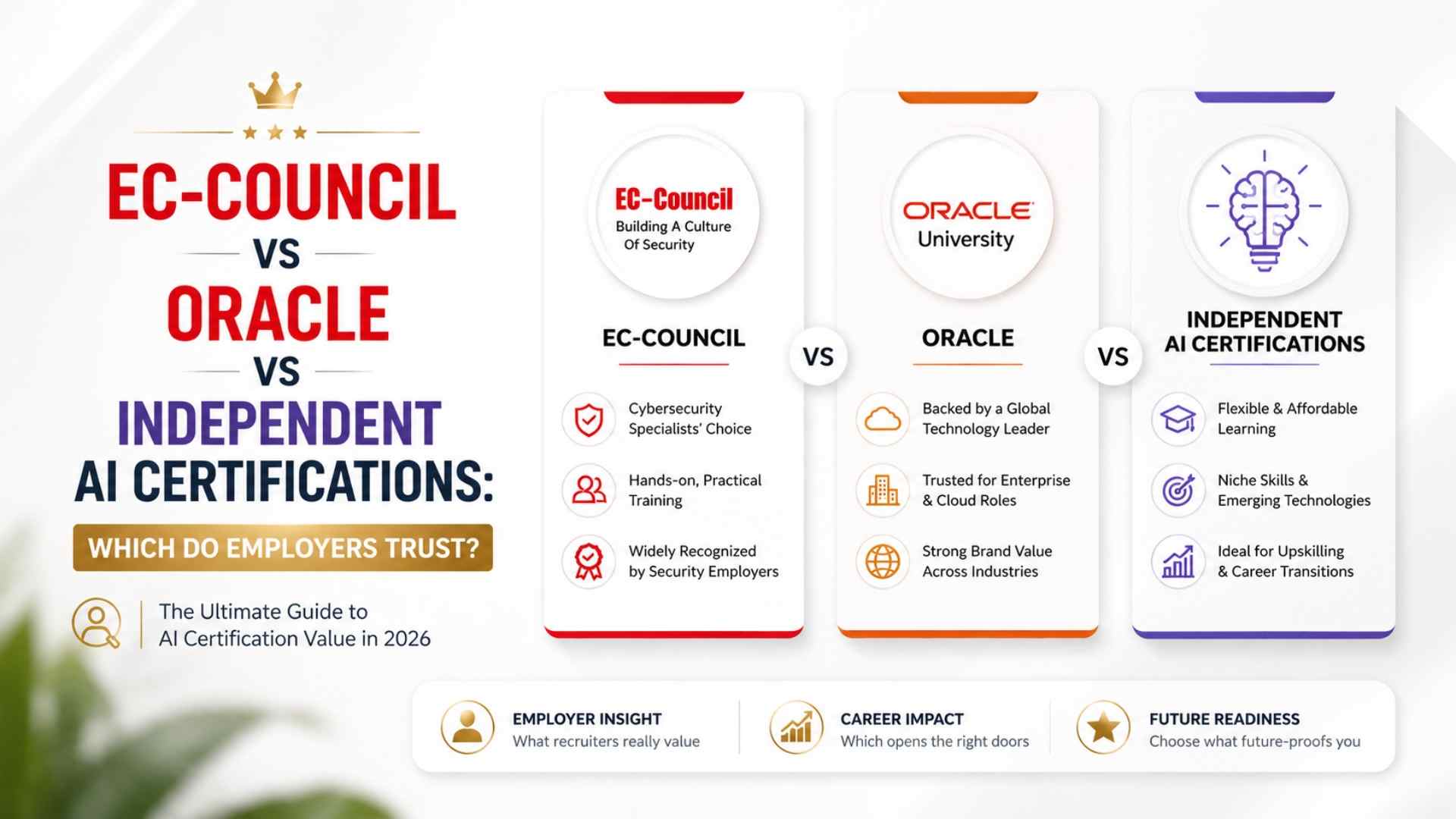
Quick answer: No single certification type wins outright. EC-Council-backed certifications carry the most weight for security-focused AI roles and government-adjacent hiring. Oracle-backed certifications carry the most weight when a job posting names Oracle Cloud Infrastructure or Oracle's data platforms directly. Independent, institution-branded certifications carry the most weight when the role cares about applied project experience and specific tool depth — GenAI frameworks, LLM deployment, data pipelines more than the credentialing body itself. The right choice depends on the job you're targeting, not which name sounds biggest.
What "Employer Trust" Actually Means for a Certification
Employers don't trust a certification the same way in every hiring stage. A credential can do three different jobs:
Pass an initial screen — get a resume past an ATS or recruiter scan
Signal platform fit — prove you can work inside a specific vendor's ecosystem on day one
Convince a technical interviewer — hold up under direct questioning about what you actually built
A certification that's excellent at job one isn't always strong at job three. That distinction is the whole story behind EC-Council vs. Oracle vs. independent credentials.
EC-Council-Backed AI Certifications: What They Signal
EC-Council is best known for the Certified Ethical Hacker (CEH) credential, and that reputation carries into its newer AI security programs. EC-Council certifications have earned accreditation against the ISO/IEC 17024 personnel certification standard, and several of its credentials are recognized under the U.S. Department of Defense's cyber workforce framework which matters directly for government, defense, and compliance-heavy hiring.
For AI-specific roles, this recognition extends to programs like the Certified Offensive AI Security Professional (C|OASP), which applies EC-Council's offensive-security credibility to LLM red teaming, prompt injection, and adversarial ML, and the Artificial Intelligence Essentials (AI|E) program, which brings that same structured, lab-based methodology to foundational AI literacy and responsible AI use.
What it signals to employers: structured methodology, hands-on lab exposure, and a name recruiters already recognize particularly strong for security-adjacent AI roles, SOC teams, and organizations with government or compliance ties. Note that even within EC-Council's own portfolio, exam type matters: knowledge-based exams and practical, lab-graded exams don't carry equal weight with technical interviewers, so hands-on program structure is worth checking before enrolling.
Oracle-Backed AI Certifications: What They Signal
Oracle certifications answer a narrower but very specific question: can you work inside Oracle's ecosystem immediately? Hiring managers generally read vendor-specific credentials this way as a signal of immediate platform fit rather than broad conceptual knowledge. When a job posting explicitly names Oracle Cloud Infrastructure, Oracle 23ai, or Oracle's data platforms, a matching certification removes ramp-up risk for the employer.
This is the lane covered by programs like the OCI AI Foundations Associate, the OCI Generative AI Professional, and the Oracle Data Science Professional — each aligned to Oracle's own certification tracks and OCI's AI and data services.
What it signals to employers: direct platform readiness. Oracle-certified professionals in adjacent cloud and data roles have reported meaningful salary premiums tied to verified platform skills, and demand for OCI-certified architects and data professionals has stayed strong as more enterprises run AI workloads on Oracle infrastructure. The tradeoff: this signal is powerful only when the employer actually runs on Oracle. Outside that context, it carries less weight than a security or general ML credential.
Independent / Institution-Branded AI Certifications: What They Signal
Independent, training-institution-branded certifications like a "Certified Generative AI Expert" or "Certified Data Scientist" issued by a training provider rather than a vendor like Oracle or a standards body like EC-Council answer a different question entirely: not "which brand issued this," but "what did the candidate actually build?"
This category includes programs such as the Technovalley Certified Generative AI Expert (GAIE), the Technovalley Certified Artificial Intelligence & Machine Learning Expert, the Technovalley Certified Data Scientist, the Technovalley Certified Data Analytics Professional, the Certified AI Program Manager (C|AIPM), and the one-year postgraduate tracks in AI Applications, Data Science and Machine Learning, Generative AI Applications, and Agentic Artificial Intelligence.
What it signals to employers: applied depth over brand recognition. These programs typically compensate for lacking a single household-name issuer by leaning heavily on project-based, portfolio-generating curricula deployed LLM applications, real datasets, capstone builds — which is exactly the evidence technical interviewers say they weigh most heavily once a resume clears the initial screen. This lane also covers specializations, like agentic AI and AI program leadership, that neither EC-Council nor Oracle currently certify at all, which makes it the default choice when the skill itself is newer than the vendor and standards-body catalogs.
Which Should You Choose?
Targeting AI security, red teaming, or compliance-heavy roles? An EC-Council-backed credential like C|OASP carries recognized, standards-aligned weight.
Targeting a company that already runs on Oracle Cloud? An Oracle-backed credential is the fastest path to signaling platform readiness.
Targeting a GenAI, data science, agentic AI, or AI leadership role where the skill itself is still new or company-agnostic? An independent, project-heavy program will usually give you stronger interview evidence than a vendor badge, because the portfolio does the convincing.
Not sure yet? Many candidates layer these a foundational independent or EC-Council program for broad literacy, followed by an Oracle credential once a target platform is clear, or a specialist track like C|OASP once a technical direction is set.
Frequently Asked Questions
Is an EC-Council certification better than an Oracle certification? Neither is universally "better" they answer different hiring questions. EC-Council signals structured, standards-aligned security methodology; Oracle signals immediate readiness on Oracle's specific platform. The right one depends on the role.
Do employers trust independent AI certifications as much as vendor ones? For newer specializations like generative AI application development or agentic AI, employers often value what the candidate actually built more than which body issued the credential largely because standardized vendor or standards-body certifications for these specific skills are still catching up.
Should I get more than one type of certification? Yes, if your career path spans categories for example, a foundational AI literacy credential plus a platform-specific one once you know your target employer's tech stack, or a security specialization layered on top of a general ML background.
Final Thoughts
"Which certification do employers trust?" is the wrong question on its own the right question is which certification answers the specific thing your target employer is trying to verify. EC-Council-backed programs prove structured, standards-recognized methodology. Oracle-backed programs prove platform-specific readiness. Independent programs prove applied, portfolio-backed skill in the newest and fastest-moving parts of the AI stack. Matching the credential to the hiring signal not the logo is what actually moves a resume forward.