



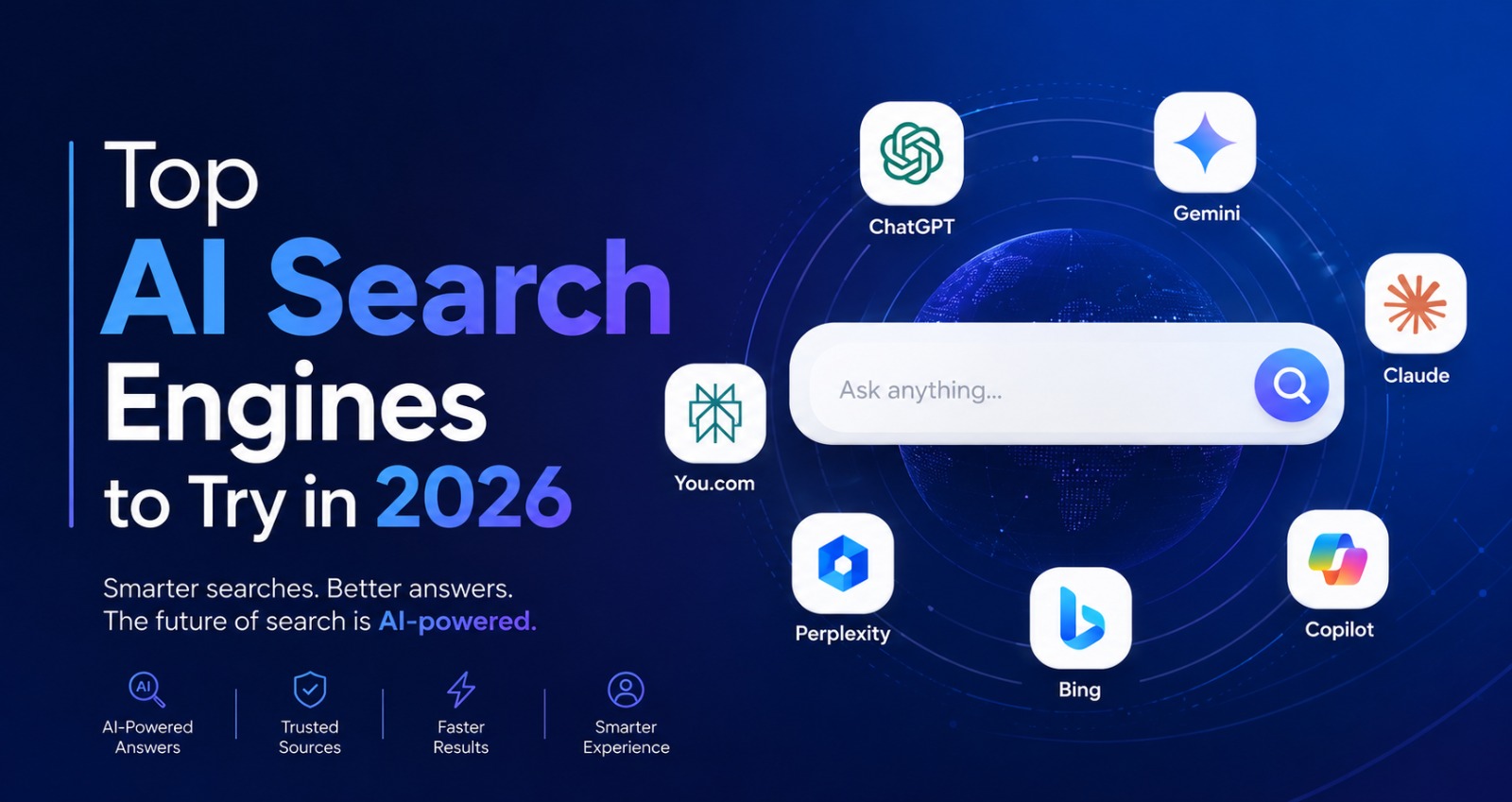
The Honest Starting Point: "Best" Depends on the Job
There's no single winner here, because these tools aren't all solving the same problem. Some are built for quick, cited answers to everyday questions. Some are rebuilt versions of a search engine you already use. Some are aimed at deep, multi-source research. Others are aimed at a clean, ad-free browsing experience that just happens to have AI answers on top. The right pick depends on what you're actually trying to do, not which one has the loudest marketing.
The AI Search Engines Worth Trying in 2026
Perplexity is the tool most people mean when they say "AI search engine." Every answer comes with numbered inline citations, so you can click through and verify a claim instead of taking the summary on faith — which matters, since AI-generated answers can still get things wrong. The free tier covers unlimited standard searches, with a daily cap on searches that use heavier models; the paid tier removes that cap and lets you pick between several underlying models in one place.
Google AI Mode isn't a separate search engine so much as Google Search rebuilt for conversation. Available through Search Labs, it lets you ask a question in plain language, get an AI-synthesised summary, and keep asking follow-ups without losing context. A "Deep Search" option goes further, pulling together a research-style report from dozens of pages at once. Its real advantage is Google's index — for local results, shopping, and long-tail queries, nothing else covers as much ground, which makes AI Mode the easiest on-ramp if Google is already your default.
ChatGPT Search is the natural pick if ChatGPT is already where you spend your day. It blends conversational answers with live web results and citations, and it's convenient precisely because it doesn't ask you to open a second tool — the search happens inside the same chat you're already using for drafting, coding, or brainstorming.
Microsoft Copilot plays a similar role for Microsoft 365-centric workplaces. Its search results are grounded in the same web index Bing uses, and for organisations already living in Outlook, Teams, and Word, the integration removes a layer of friction that a standalone tool would add.
Brave Search takes a different approach: it's a full, independent search index (not just a wrapper on Google or Bing) with an AI answer summary layered on top, no account required. It's a reasonable pick for anyone who wants AI answers without handing more data to the larger platforms.
Kagi skips ads entirely and charges a subscription instead, which changes its incentives — its ranking isn't paid for, and its AI features sit on top of a genuinely independent index. It's the "clean web" option for people who've decided they'd rather pay a few dollars a month than deal with ad-optimised results.
Consensus is worth a specific mention if your search is academic or research-driven — it pulls answers only from peer-reviewed sources, which makes it far more reliable than a general-purpose tool for anything citation-sensitive.
If you're curious about what's actually happening under the hood — how these tools combine retrieval with a language model to generate a grounded answer — that's the same retrieval-augmented generation (RAG) pattern powering most modern AI search. Our beginner-friendly breakdown, What Is RAG? A Complete Beginner's Guide, walks through it in plain English. If you want to go further and actually build with LLMs, embeddings, and retrieval pipelines like these, Technovalley Generative AI Expert (GAIE) program covers exactly that ground, from Python basics to deployed LLM applications.
What Actually Matters When You're Choosing
Benchmark comparisons of these tools tend to miss the practical questions that decide whether you'll actually keep using one:
Does it cite sources you can verify? This is the single biggest differentiator between "AI search" and "an AI chatbot that sounds confident." If you can't click through and check a claim, treat the answer as a starting point, not a conclusion.
Does it fit into tools you already use? A technically superior search engine that adds a fifth tab to your workday loses to a decent one that's already sitting inside your email client or IDE.
How does it handle ambiguous or fast-moving queries? Test each tool on something genuinely current — a recent news event, a product that just launched — before trusting it with real work. This is also where hallucination risk is highest, so cross-check anything that matters.
What happens to your data? Free consumer tiers and paid/business tiers of the same tool often have different data-handling and training-opt-out terms. Worth checking directly if you're using these for anything work-related.
The Skill That Matters More Than Which Tool You Pick
None of these tools remove the need to read critically. AI search still summarises, still occasionally misreads a source, and still reflects the biases of whatever it was trained and grounded on. The differentiator isn't which search engine you choose — it's whether you know how to phrase a query that gets a useful answer, and how to evaluate what comes back instead of accepting it at face value. Our post Prompt Engineering: A Practical Guide Beyond the Basics covers techniques that transfer directly to how you query any of these tools, and I Don't Want to Surrender to an AI — How to Use AI Without Becoming a Slave? is worth reading on the discipline side of relying on AI-generated answers.
Building This as a Formal Skill, Not Just Habit
If you're using AI search tools daily but have never had formal training on evaluating AI-generated output for accuracy, bias, or appropriate use, that's a real gap — and it's exactly what Technovalley AI Essentials (AI|E) program is built to close. It's tool-agnostic by design, teaching the underlying literacy that applies whether you're using Perplexity, Google AI Mode, ChatGPT Search, or whatever replaces them next year.
FAQs
Is AI search accurate enough to replace traditional search entirely? Not yet, for everything. It's strong for quick answers and cited summaries, but for anything high-stakes — legal, medical, financial — verify against the original source rather than trusting the summary alone.
Do I need to pay for a premium tier to get real value? For occasional use, free tiers are usually enough. For daily, work-critical use, paid tiers typically remove search caps and unlock stronger underlying models, which is worth it if you're relying on the tool regularly.
Will AI search replace traditional search engines completely? Unlikely in the near term. Traditional search still wins for breadth — local results, shopping, and long-tail queries — which is why most AI search tools are built on top of an existing index rather than replacing it outright.
Build the AI literacy that lets you get more out of any search tool you use. Explore the AI|E program or talk to our academic team. Start writing your blog...
This editor supports bold, italic, underline, lists, code blocks, links, alignment and more.