



We’ve all been there. You’re staring at a blank document looking for ideas or, struggling to phrase an email, or trying to debug an issue prone line of code. Your brain is in a fog, ideas are having friction. Looks familiar,no? To squeeze out that creativity and the uncomfortable effort for it.
There comes our small window- The AI chat bot . With a quick copy-paste, or a small prompt with minimum words, the machine spits out a flawless answer in a few seconds. You feel a wave of relief. But if you listen closely, you might also hear a silent mourning : “I couldn't figure that out on my own. Am I enslaving myself to this genie in the box”
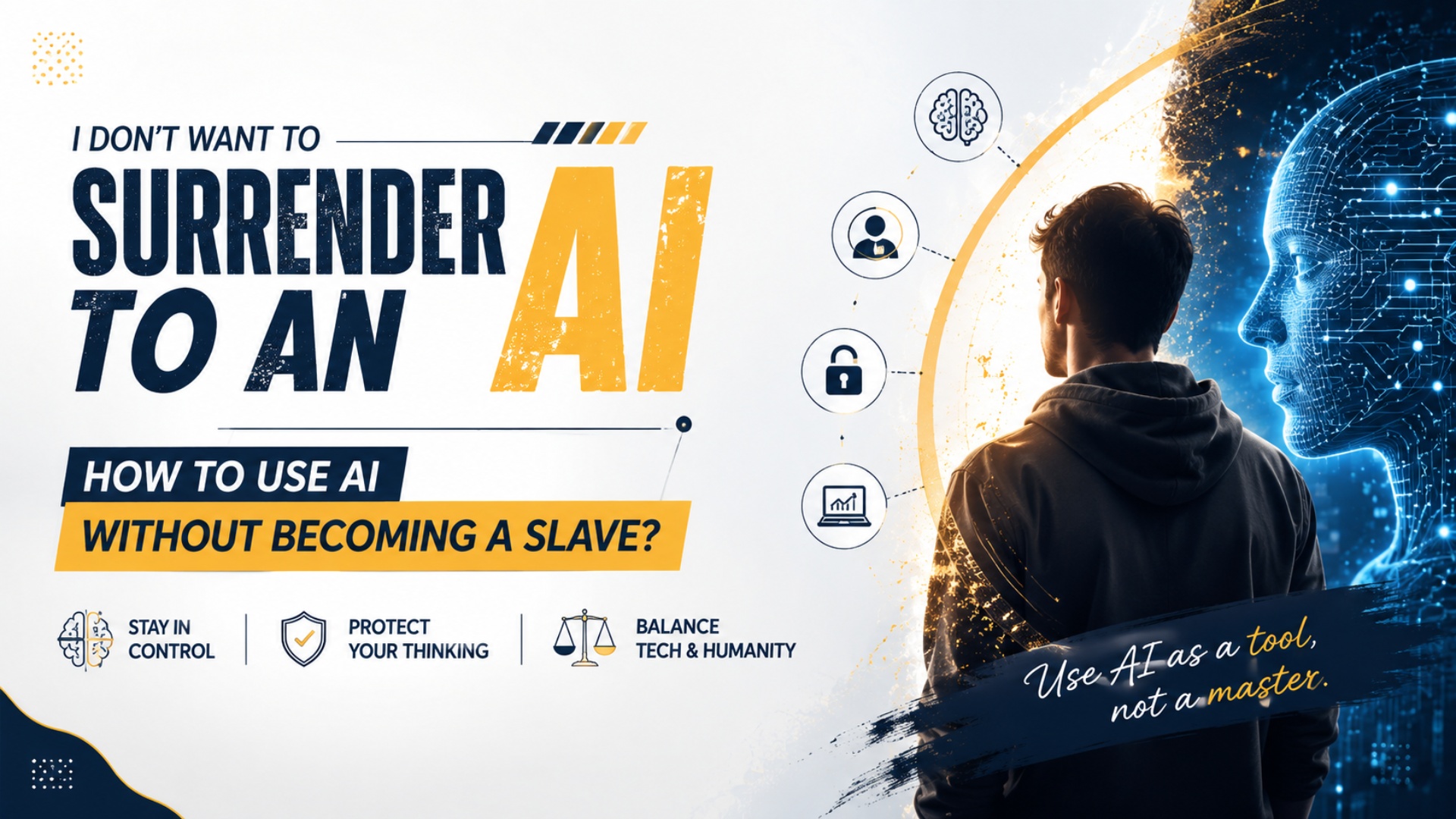
I hate to say this but every time you outsource a basic thought, you aren't just saving time or saving your face- instead you are subtly admitting defeat to a machine. If this micro-surrender happens every time you are faced with creativity(however minor a task it might be), you risk turning from the master of technology into its slave. How can I rely on AI , use it as a weapon to sharpen our wits, rather than a walking stick that I lean to whenever and as ever needed.
Casual Delegation- What’s that?
Here lets understand how casual delegation- that is prompting or using agents in AI to handle even trivial questions. Is it addictive? And whether we tend to lose our abilities? Yes, as per research and by our general experiences over the past few years. Is it building a dangerous micro-dependency?
Think about driving our vehicle around an unknown path without GPS. That's absolutely fine. But using it for a route you've driven many times is what can happen depending on AI. If the screen goes blank, you are suddenly lost in your own neighborhood and you struggle hard to find the route by actually looking at the road, the landmarks that you remember and talking to strangers, taxi fellows or shop keepers on the way. Seems like we have elevated our living to the lives of the Sci-Fi movie- “Wall-E”. Will the same things not happen to our cognitive thinking parts when we use AI for daily tasks that don't require the AI really.
For that we need to fight through the discomfort of problem-solving, utilize our logical and technical reasoning capabilities, or else as with every unutilized muscle in our body, the brain may also shrink in its capabilities over time.
What makes us human? The weirdness in our thoughts, the messy, unpredictable sparks of creativity that is an Eureka for us,but madness for others, the big small mistakes that pop up in our regular writings- that is what makes us human. All our previous tech inventions always eased our work, but left the creativity part to us. However AI is different and it snatches that aspect also from us. Naturally developing this Overdependence replaces this very authentic synthesis of ideas and thoughts with generic, algorithmic output. You stop thinking because of this and; you just start curating and even worse copy pasting.
Make your Brain workout- It's a Gym,not a godown!
The point is not to allow your thought-making machine to become a Warehouse. Because that will be an endgame for us- as every doomsday yearner will tell…they say that the human brain functions in such a way that our brain does not act like a storage locker, that stays perfectly unaffected, regardless of what you put in it. Your brain is a muscle.
Neuroscientists as we have found out that brain’s neuro plasticity (its rewiring ability as if faces a challenge- harder the struggle,stronger the neural pathways) and cognition reserve ability(that acts as a mental buffer protecting us from dementia like illnesses) reduces its functions as we don't give work to it by delegating the very tasks that it was supposed to do
If you go to the gym to view how a forklift crane can lift weights for you don't make you stronger. Right? You're just watching a machine work. Letting AI do your thinking is the intellectual equivalent of using a forklift at the gym.
How Flipping the Prompt is Good for Your Brain?
Here we are trying to adopt the "Me First" Workflow. What it means is that we try to keep our edge first by establishing a strict boundary while prompting. We use the strategy of-: Human give the lead and synthesize, AI will beautify and optimize. Instead of asking the AI model to build something from scratch, by giving a general prompt, lets start adopting the Critique Method. How does it works? Read on ….
1. Write a First Draft: Whatever the task or question in hand, lets try and force ourselves to write out an answer or solution first. It doesn’t matter how stupid, clunky, messy it is, or little content it has. Try to force the brain to do the heavy lifting of constructing or compiling from different sources the core logic.
2. Flip the Prompt to AI: Do not type as prompt, "Write this or that / Draft this for me." Instead, paste your messy attempt and type: "Have a look at this draft. Analyze and Point out if there are logical gaps. You may also critique my phrasing, grammar, extra points to be included and show me how it can be improved."
3. Use AI-powered source-grounded assistant: NotebookLM fits this category. It's an AI research, note-taking, and multiple format generating assistant developed by Google that needs an input from you , whether it’s a pdf, ppt or webpages that you have gone through and that have relevance to the subject matter. By doing these, let's keep the intellectual upper hand. Let's assume the role of the manager reviewing a subordinate's or a student’s feedback, not a student begging a teacher for the answers.
Curating is Fine, Copying is Not
When the AI gives the suggestions, never copy and paste the entire response. Treat that as a buffet of ideas, not a full package tour, where we blindly follow your tour operator. Take the betterment suggestions, structural pointers, and vocabulary/grammar alternatives and we can adopt a better logical sequence it suggested. Take some effort to physically rewrite the final product yourself. It might take a few minutes or hours of our time. But practice it like that. Its better to spend some time on this rather than being exposed by an AI generated content recognition system, forcing the person to apologize and withdraw your “creation”.
By forcing the ideas through our own language and manually feeding it to the memory will make the work truly our own , or the least is that it will allow you to absorb the lesson.. You learn why the AI's suggestion was better, ensuring that next time, your first draft will be sharper. Use AI Purely as a Cosmetic Polish to brush off the imperfections that are inherent in human work, but not to the extent that it really doesn't feel human any more
Let our AI helper handle the aesthetics and the cosmetic wrapping, but make sure the work and idea inside is entirely ours.
Conclusion
Artificial Intelligence is an amplifier for the cognitive functions of the brain. If we use it lethargically and without much thought prompt it to give outputs, it will simply make us lazier. It will also eventually erode our excellence and the ability to think critically. But if we practice ourselves to become a sharp thinker, we can use it as a sparring partner and can allow our works to be elevated to entirely new heights. Thus, let us raise our ceiling, by not lowering our floor. AI should not be used to escape the struggle of thinking,but should make our original work easier and make our work more complete by converting our thinking to be bulletproof.