



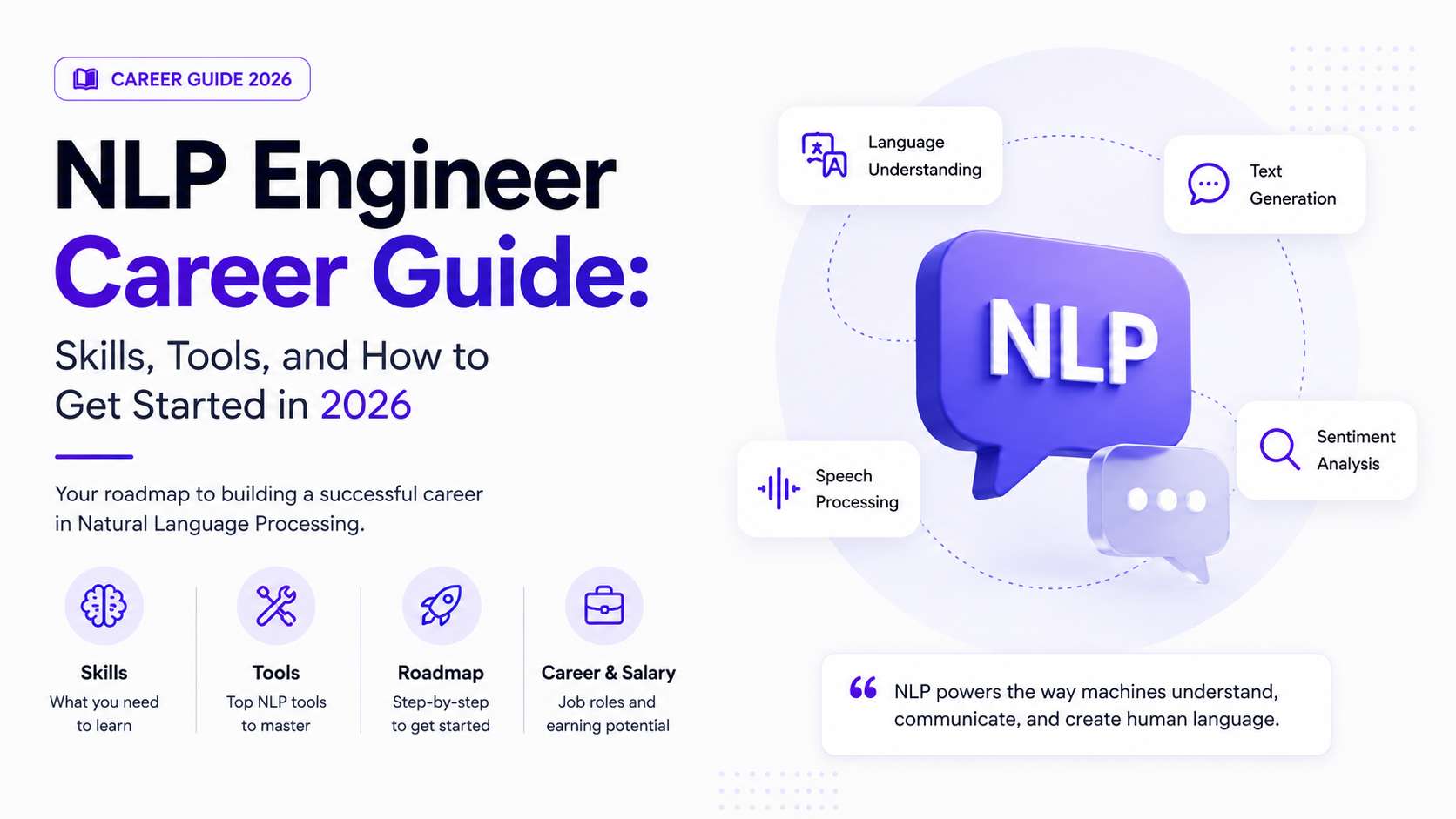
Natural Language Processing used to be a fairly academic specialisation. The rise of LLMs has turned it into one of the most commercially central skill sets in AI — because every chatbot, document-search tool, and voice assistant depends on it. Here's what the role actually looks like now.
What an NLP Engineer Actually Works On
NLP work in 2026 spans a wider range than it used to, from classical text processing to modern LLM-based systems:
Text classification and sentiment analysis — categorising support tickets, analysing customer feedback at scale
Named entity recognition and information extraction — pulling structured data (names, dates, amounts) out of unstructured documents
Building and fine-tuning LLM-based applications — chatbots, document Q&A systems, summarisation tools
Search and retrieval systems — increasingly built on the vector search and RAG techniques covered in our post Vector Databases Explained: The Backbone of Every RAG System
Most modern NLP work leans heavily on LLM-based approaches now rather than the older statistical NLP pipeline entirely — though understanding both remains valuable, particularly for cost-sensitive or latency-sensitive use cases where a full LLM call isn't the right tool.
Core Skills to Build
Python and deep learning fundamentals are foundational — most modern NLP work sits on top of transformer-based deep learning models, so a working understanding of how these models process text is essential, not optional.
Prompt engineering and LLM application development have become central to NLP work specifically because so much of it now runs through pretrained LLMs rather than models trained from scratch. Our post Prompt Engineering: A Practical Guide Beyond the Basics covers techniques directly relevant here.
Framework fluency — Hugging Face Transformers remains the standard library for working with pretrained language models, alongside LangChain or LlamaIndex for building applications around them; see our comparison, LangChain vs LlamaIndex: Which Framework Should You Learn First?.
Where to Build These Skills
Technovalley's Technovalley Certified Artificial Intelligence & Machine Learning Expert program includes NLP as a core module alongside Deep Learning and Computer Vision, giving you the broader context NLP work sits within. For a more LLM-and-Generative-AI-centred path specifically, GAIE covers Hugging Face, LangChain, and modern LLM-based NLP application-building directly. Learners wanting the deepest possible coverage should look at the One Year Post Graduate Program in Artificial Intelligence Applications, where NLP is covered across a full semester alongside Deep Learning and Reinforcement Learning.
FAQs
Is NLP still a distinct specialisation, or has it merged with Generative AI engineering? The lines have blurred significantly — most current NLP roles do involve LLM-based work, though classical NLP techniques remain relevant for specific, cost- or latency-sensitive use cases.
Do I need a linguistics background for NLP work? No — while it can help with intuition around language structure, NLP engineering today is overwhelmingly a machine learning and software engineering discipline, not a linguistics one.
What's a good first NLP project for a portfolio? A document Q&A system or a sentiment-analysis dashboard over real, messy data (customer reviews, support tickets) demonstrates practical skill more convincingly than a toy dataset exercise — the same principle covered in our post How Technovalley's Capstone Projects Actually Work.
Build a real NLP skill set with hands-on projects. Explore Technovalley's AI programs or talk to our academic team.