



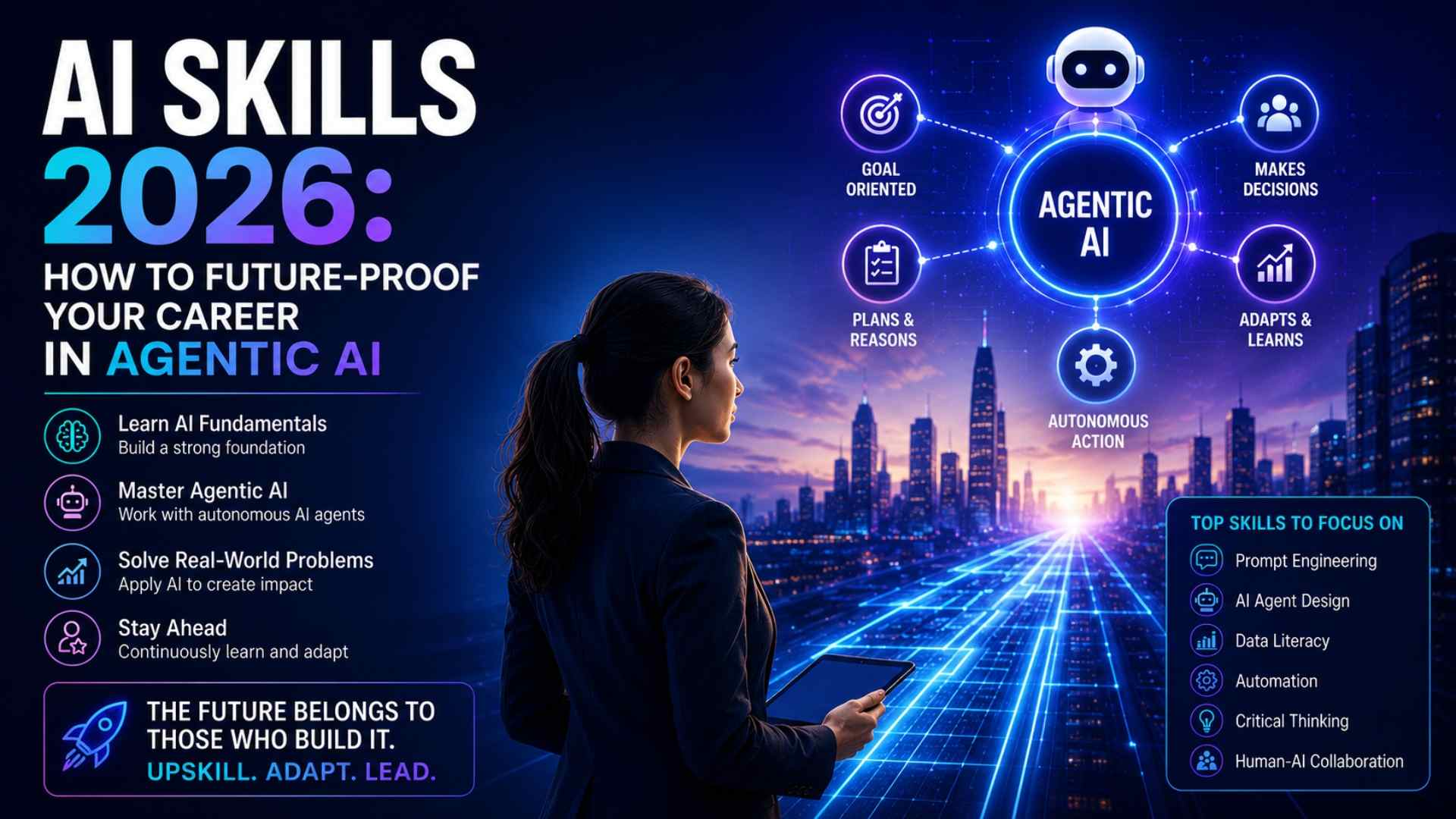
AI has evolved from an email drafting or content-generating assistant into a digital coworker capable of automating and executing tasks on your behalf. As AI becomes more autonomous, professionals must upgrade their skill sets to remain valuable in the workplace and business environment.
To stay relevant in the age of agentic AI, focus on mastering the following three pillars.
1. Agent Architecture & Orchestration
Modern AI systems increasingly rely on multiple agents working together to complete complex tasks. Rather than simply learning how to use an AI agent, professionals should understand how to design and orchestrate networks of agents.
What to Learn
Agentic frameworks such as LangChain, CrewAI, AutoGen, and LangGraph.
Multi-agent workflow design and orchestration.
Role assignment and collaboration between specialized AI agents.
Building AI systems that automate and manage business processes.
2. Advanced Tool Integration & API Management
AI agents become significantly more powerful when connected to tools, databases, memory systems, CRMs, emails, and external applications. Organizations need professionals who can securely integrate these systems and enable AI agents to interact with real-world resources.
What to Learn
Python programming fundamentals.
API integration and management.
Vector databases and retrieval systems.
Database connectivity and workflow automation.
Integration with enterprise applications and proprietary software.
3. AI Governance, Guardrails & Ethics
Autonomous AI systems can make costly mistakes if left unchecked. Organizations must establish safeguards to prevent unintended actions, security risks, compliance violations, and unauthorized transactions.
What to Learn
AI guardrail implementation techniques.
Defining operational boundaries for autonomous systems.
AI auditing and decision-trace analysis.
Ethical AI development practices.
Compliance and enterprise AI governance.
Your Next Step: Choosing the Right AI Certification Course
The fastest way to move from being a prompt engineer to becoming an AI architect is through structured and practical learning. Future employers will increasingly value professionals who understand how to build, manage, and supervise AI agents.
When evaluating AI certification programs, ensure the curriculum reflects the shift toward agentic AI and autonomous systems.
What to Look for in a 2026 AI Certification Program
Hands-on Agent Frameworks
Practical training with CrewAI, AutoGen, LangChain, and LangGraph.
Exposure to open standards and orchestration libraries.
Learning OCI Agent Development Kit (ADK) if working with Oracle OCI environments.
System Design
AI architecture fundamentals.
Memory management techniques.
Stateful workflows and autonomous agent loops.
Scalable AI system design.
Enterprise Security
AI safety and governance principles.
Guardrail implementation.
Secure API deployment.
Enterprise-grade security practices.
Beyond Prompts and Outputs: Master the 4-Layer Agent Evaluation Framework
Building an AI agent is only the beginning. To deploy reliable production-grade systems, professionals must learn how to evaluate agents across multiple architectural layers.
Layer 1: Component Testing
Evaluate and benchmark individual system components.
Prompt testing.
RAG and retrieval system evaluation.
Custom tool validation.
Raw model output assessment.
Layer 2: Trajectory & Reasoning Analysis
Analyze how agents reason, plan, and make decisions across complex workflows.
Reasoning trace analysis.
Decision path evaluation.
Multi-step task assessment.
Planning effectiveness measurement.
Layer 3: End-to-End Outcome Metrics
Measure whether the agent successfully achieved the intended objective.
Define success criteria.
Track outcome quality.
Measure task completion accuracy.
Validate business impact.
Layer 4: Adversarial & Edge-Case Stress Testing
Test how agents respond to unexpected situations, failures, and malicious inputs.
Adversarial attack testing.
System failure simulation.
Edge-case validation.
Reliability and resilience assessment.
Conclusion
The AI revolution is no longer a future possibility—it is already transforming industries through sales automation, HR analysis, customer retention strategies, legal research, and financial decision-making. New AI models and agentic systems continue to emerge at an unprecedented pace.
To remain competitive, professionals must shift their focus from simple content generation toward building, orchestrating, evaluating, and governing autonomous AI systems. By developing expertise in agent architecture, tool integration, and AI governance, you position yourself to work alongside AI as a supervisor, architect, and manager rather than being replaced by it.