



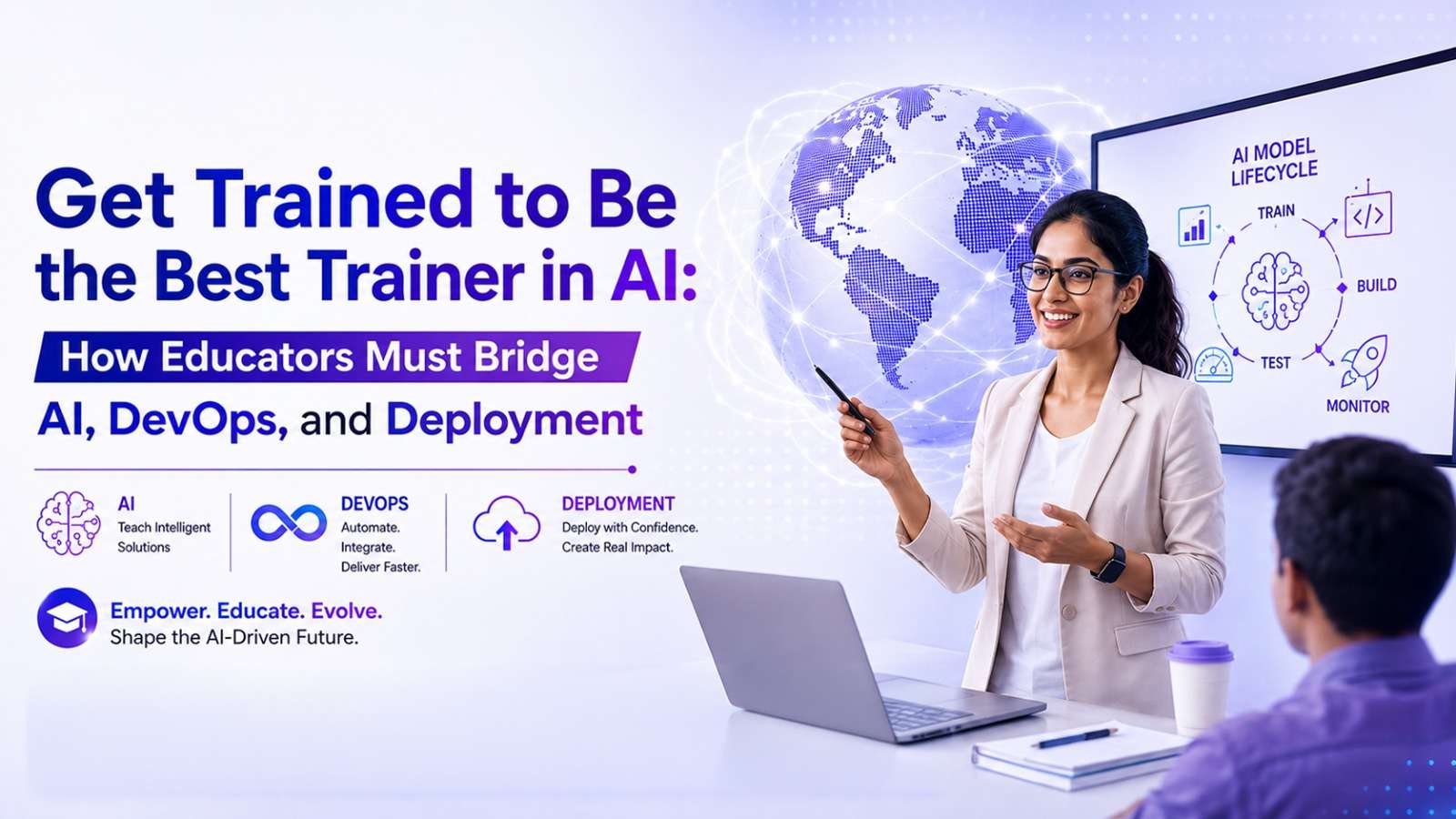
The students were to be taught on how to clean data, train a model in a Jupyter Notebook, introduce R. The practicals were meant to do data cleaning, achieve high accuracy, and evaluate loss curves. However, in today’s modern tech explosion with newer AI models coming out every day and more designs getting publicity, a model stuck in a notebook is worthless.
To prepare students for real-world AI industries and the latest software engineering shifts, educators also need to evolve. University syllabus may take time to change,but your projects that you give to students to train on should be the latest. For that ,its not sufficient to teach Artificial Intelligence in isolation, as a mere theory topic. Today's top academic institutions need to integrate DevOps, MLOps, and Automated Deployment pipelines directly into their pedagogical toolkits. To be the best trainer in AI, you must train developers, ie. your students who know how to plan, create, ship, scale, monitor, and maintain AI based intelligent systems.
What is the new trend ?
In industry, building the AI model accounts now is taking a big share ( roughly 15-25%) of the total engineering work and skills are needed desperately in that. The remaining 80% is traditional engineering including data ingestion, orchestration, infrastructure management, continuous deployment, and monitoring is also in demand. We have seen the industry giving out hue and cry where they complain that computer science graduates possess theoretical AI knowledge but lack basic operational awareness.
As an educator, you need to become a master trainer means reframing your core curriculum around the full Lifecycle of Machine Learning (MLOps), and the refresher programs in colleges and universities must be oriented towards these goals. The managers and VCs of the academies need to implement the following in a war-footing to achieve synchronization with the industry needs now
Continuous Integration / Continuous Deployment (CI/CD): Automated testing not just for code quality, but for data validation and model performance checks before release.
Containerization & Orchestration: Teaching Docker and Kubernetes so models run consistently across local development, staging, and production environments.
Infrastructure as Code (IaC): Equipping students to deploy compute resources dynamically using tools like Terraform or CloudFormation.
Educator Insight needs to be upgraded and if your students submit projects as raw .ipynb files(Jupyter notebook files), they aren't ready for the market. They need to learn production engineering. For this the tutors need to give lessons on howto export code into structured packages, build Docker containers, and deploy behind an API gateway using FastAPI or Flask.
How can Technovalley Upskilling Programs Bridge the Gap?
To lead this transformation effectively, educators must first acquire hands-on proficiency in production workflows. Technovalley Software India—a recognized Centre of Excellence in Talent Engineering—offers specialized, industry-aligned certification pathways designed to bridge the gap between theoretical AI and modern cloud deployment.
Technovalley Certified AI & ML Expert: Provides deep exposure to supervised learning, neural networks, NLP, Computer Vision, and Generative AI workflows. It teaches how to build, optimize, and prepare ML models for live software environments.
Technovalley PG Program in Data Science & Machine Learning : A comprehensive 70% practical-oriented curriculum that trains educators across full end-to-end data pipelines—from Python scripting and statistical modeling to model evaluation and production deployment.
Technovalley DevOps Program: Equips trainers with essential operational tools, including Docker, Kubernetes, Terraform, Git, Jenkins, and continuous telemetry stacks like Prometheus, Grafana, and Nagios.
Technovalley Certified Data Scientist: Focuses on practical problem-solving using open-source toolchains, statistical inference, and capstone deployment projects reflecting live industry scenarios.
By pairing Technovalley AI & ML Expert Certification with their DevOps Program, educators gain complete command over the entire MLOps lifecycle—positioning them as premier AI trainers in the market.
How to Train Yourself to Be the Best AI & DevOps Educator
To teach cutting-edge technologies, educators must constantly upskill:
Master the Modern Tools : Know the industry-standard tools like Docker, Kubernetes, GitHub Actions, MLflow, and cloud-native AI services.
Adopt Agile Teaching Methodologies: Treat project submissions and course materials as software product iterations. Run short, weekly sprint cycles where students submit working increments of their AI applications rather than a single mid evaluation.
Emphasize Observability & Responsible Deployment: Educate students on extremities and edge cases like what to do when the model encounters data drift or on how to do cloud costs scaling when traffic spikes
Monitoring is part of the project- Integrating monitoring tools into student projects prepares them for real-world enterprise constraints.
Conclusion: Preparing Industry-Ready AI Engineers
The gap between modern industry demands and traditional technical education especially in CS is wider than ever. Educators who leverage Technovalley AI, Data Science, and DevOps certifications can bridge this critical gap, transforming passive learners into high-impact engineering talent. By moving beyond theoretical algorithms and mastering operational deployment, you position yourself at the absolute forefront of technical education. Students gain, the institution gain - the industry and nation in turn benefit from your resolve to learn the tech needed for this new age of AI.