



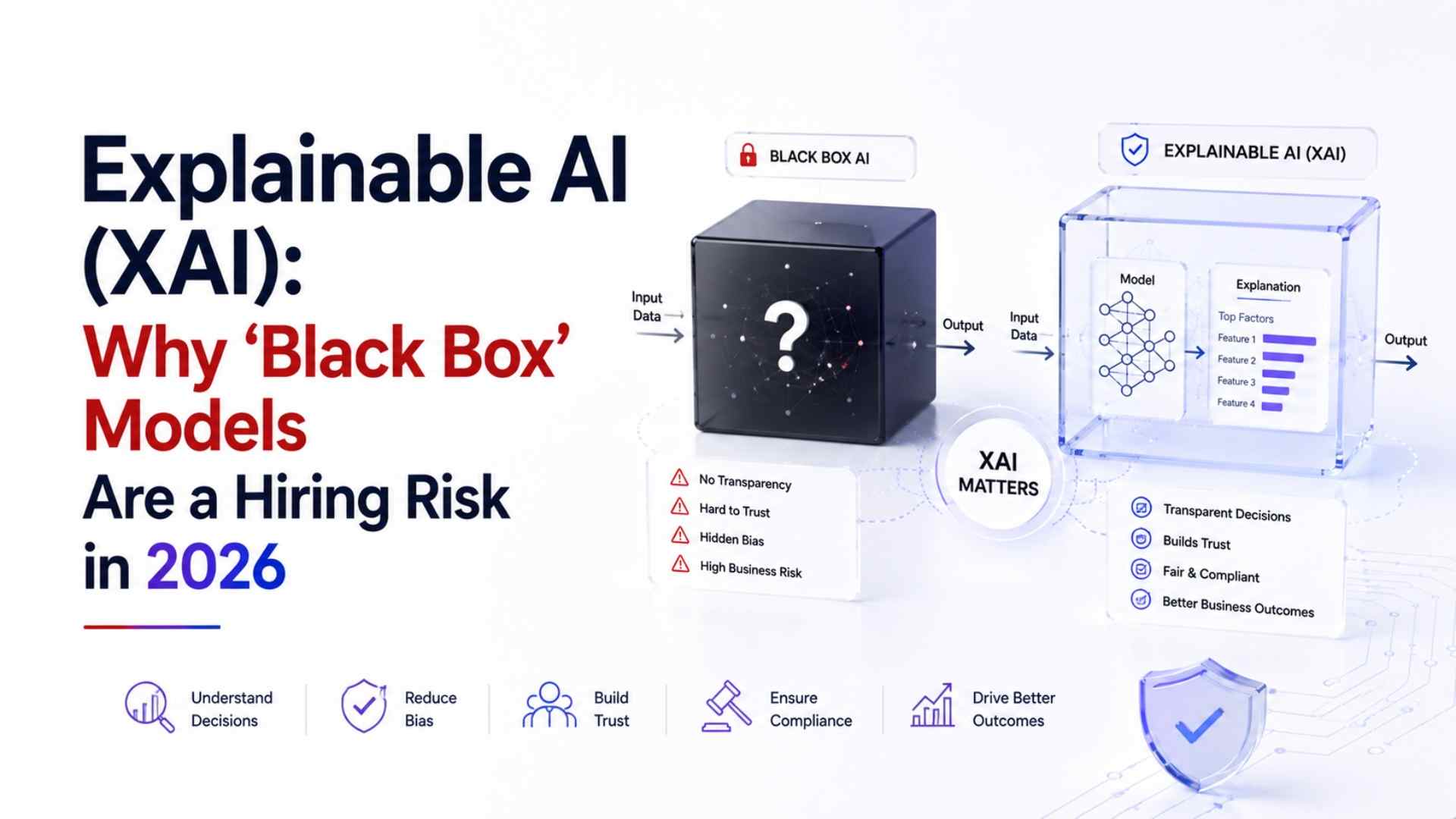
Explainable AI (XAI): Why "Black Box" Models Are a Hiring Risk in 2026
"The model is 94% accurate" used to be enough to end a conversation. In 2026, it's often the start of one — because the next question, increasingly asked by regulators, business stakeholders, and interviewers alike, is: "Why did it make that specific decision?" If your answer is "I'm not entirely sure," that's a real problem, and it's become a real hiring risk.
What "Black Box" Actually Means, and Why It's a Problem
Many high-performing ML models — especially deep neural networks and complex ensemble methods — don't naturally expose why they arrived at a given prediction. That's fine for low-stakes applications (a movie recommendation that's wrong costs nothing). It's a serious problem for credit approval, hiring screening, medical diagnosis support, or fraud detection, where an unexplainable wrong decision carries real consequences and, increasingly, real regulatory exposure.
Explainable AI (XAI) as a Discipline
XAI is the set of techniques used to make model decisions interpretable — for both technical and non-technical stakeholders. Core techniques worth knowing:
SHAP (SHapley Additive exPlanations) — quantifies how much each input feature contributed to a specific prediction
LIME (Local Interpretable Model-agnostic Explanations) — approximates a complex model's behaviour locally around a specific prediction with a simpler, interpretable model
Feature importance analysis — broader, model-level view of which inputs drive predictions overall, versus SHAP/LIME's per-prediction focus
Inherently interpretable models — sometimes the right call is choosing a simpler, explainable model (like a decision tree) over a marginally more accurate black-box model, specifically because explain ability is a requirement, not a nice-to-have
Why This Has Become a Hiring Criterion, Not Just an Ethics Talking Point
This shift isn't abstract — it's regulatory and commercial. The NIST AI Risk Management Framework explicitly identifies explain ability as a core pillar of trustworthy AI, and regulations like the EU AI Act have made explain ability a compliance requirement for high-risk AI systems, not just a best practice. Enterprises deploying AI in regulated industries — finance, healthcare, insurance — now routinely ask candidates directly how they'd explain a model's decision to a compliance officer or an affected customer, not just to a fellow data scientist.
Where This Fits Your Career Path
If you're building models without ever being asked to explain a specific prediction, that's a gap worth closing before it shows up in an interview. This connects directly to the interview preparation ground covered in Top AI Interview Questions and How to Actually Answer Them in 2026, and to the broader governance perspective in our existing post AI Governance Basics: What Every Business Needs to Know Before Deploying AI.
Technovalley's Oracle Data Science Professional program includes model explain ability as part of its MLOps curriculum — reflecting that deploying a model responsibly now includes being able to explain it, not just monitor its accuracy. For learners specifically focused on the governance and organisational side of this, the Certified AI Program Manager (C|AIPM) program covers explain ability as part of its broader AI governance and compliance training.
FAQs
Is explainability only relevant for regulated industries? It's most legally critical there, but increasingly expected across the board — stakeholders in any industry are more willing to trust and adopt AI systems they can understand, which affects adoption success even outside regulated sectors.
Do simpler, more explainable models always sacrifice accuracy? Not always — the gap has narrowed significantly as XAI tooling has matured, and for many business problems, a well-tuned interpretable model performs close enough to a black-box alternative that the tradeoff clearly favours explain ability.
Which tools are most commonly used for XAI in practice? SHAP and LIME remain the most widely adopted, largely because they work across many model types without requiring a specific architecture.
Build model explain ability into your AI skill set. Explore the Oracle Data Science Professional program or talk to our academic team.