



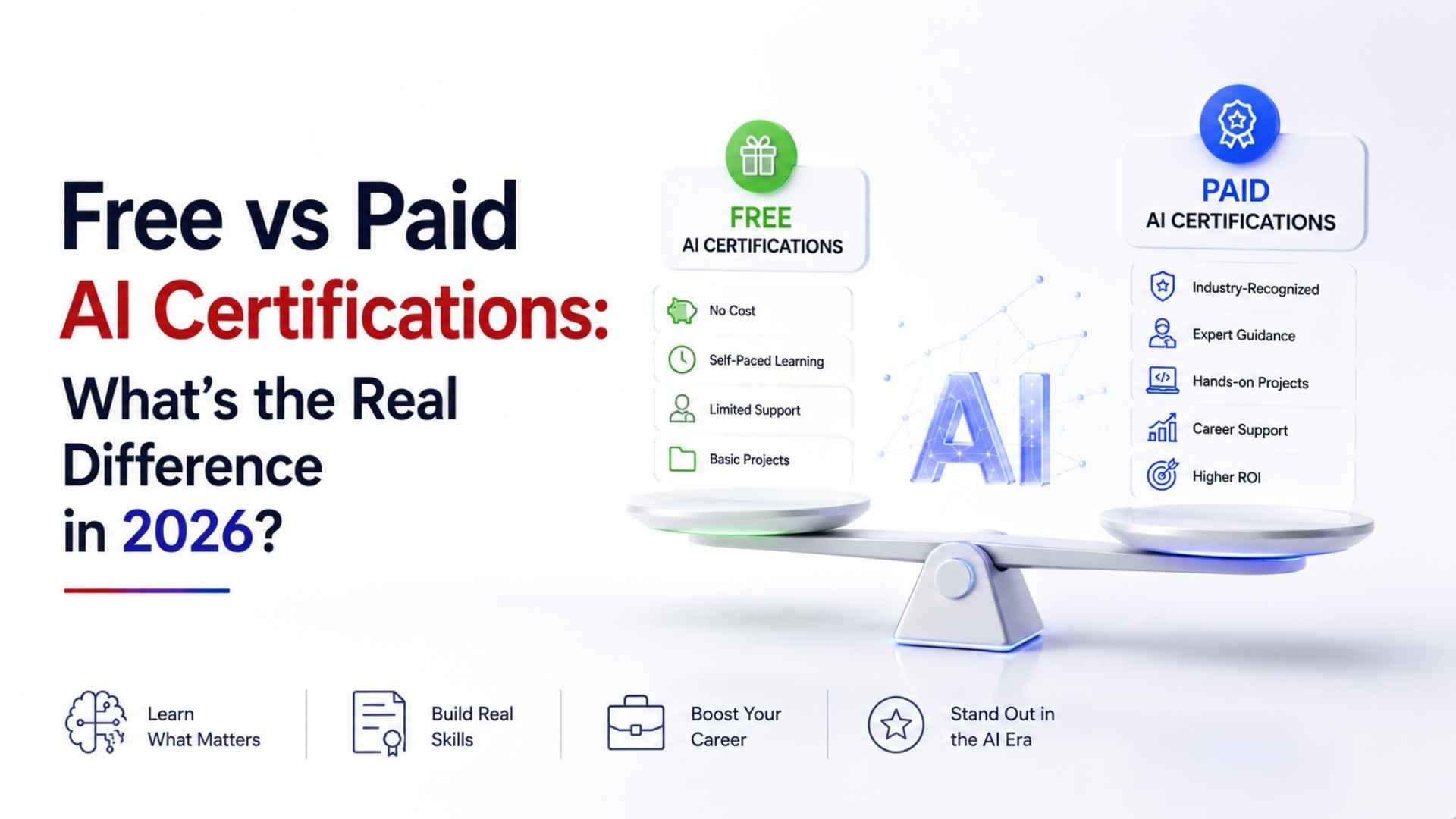
Free vs Paid AI Certifications: What's the Real Difference in 2026?
There are genuinely excellent free AI resources available in 2026 — this isn't a piece arguing free content is bad. It's a piece arguing that "free" and "paid" AI credentials usually aren't competing for the same outcome, and conflating them leads to disappointment on both sides.
What Free AI Courses Are Actually Good For
Platforms like DeepLearning.AI's short courses, YouTube tutorials, and free-tier content from major cloud providers are genuinely strong for:
Testing whether a topic (say, LLMs or computer vision) interests you before committing time or money
Learning a specific, narrow skill quickly — a particular library, a single technique
Staying current on fast-moving topics between formal training cycles
What they're structurally not built for: verification, structured mentorship, and a portfolio-ready outcome. A free YouTube certificate of completion and a credential from an accredited training partner carry very different weight with a recruiter, and pretending otherwise doesn't help anyone make a good decision.
What You're Actually Paying For With a Program Like Technovalley's
The honest value proposition of a paid, structured program isn't "access to information you couldn't otherwise find" — nearly all AI concepts are documented somewhere for free. It's:
Structure and sequencing — a curriculum built to take you from point A to point B in a coherent order, rather than you assembling fragments yourself
Mentorship and accountability — 1-on-1 guidance when you're stuck, and a structure that makes finishing far more likely than a self-paced free course (completion rates for free online courses are notoriously low)
A verifiable credential — one that's checkable against a real accrediting body, the same principle behind our recent post on Technovalley's Microsoft Global Training Partner status
A defensible portfolio piece — a mentored capstone project, not a self-graded exercise; see How Technovalley's Capstone Projects Actually Work
A Realistic Way to Combine Both
The strongest approach for most learners isn't "free vs. paid" as a binary choice — it's sequencing them. Use free resources to explore and confirm genuine interest in a specific area (say, Generative AI or cybersecurity), then commit to a structured, accredited program once you know that's the direction worth investing real time and money in. This is precisely the logic behind starting with a foundational program like AI|E before committing to something like a full one-year postgraduate program — confirm direction cheaply and quickly, then invest deeply once you're sure.
If cost is the primary constraint, our post Which Technovalley AI Program Gives You the Best ROI? breaks down how to think about value across Technovalley's own catalogue specifically.
FAQs
Are free AI certificates recognised by employers? Generally not weighted heavily on their own — they're more useful as evidence of self-directed initiative than as a primary credential, particularly for competitive roles.
Is it a waste of time to do free courses before a paid program? No — using free resources to confirm interest and build basic familiarity before committing to a paid, structured program is a genuinely sound strategy, not a wasted step.
What's the biggest risk with relying only on free courses? Incompleteness and lack of accountability — free course completion rates are low industry-wide, and without mentorship, gaps in understanding often go uncorrected until they surface in an interview or on the job.
Ready to move from exploring to a structured, credentialed skill set? Explore Technovalley's AI certification catalogue or talk to our academic team.