



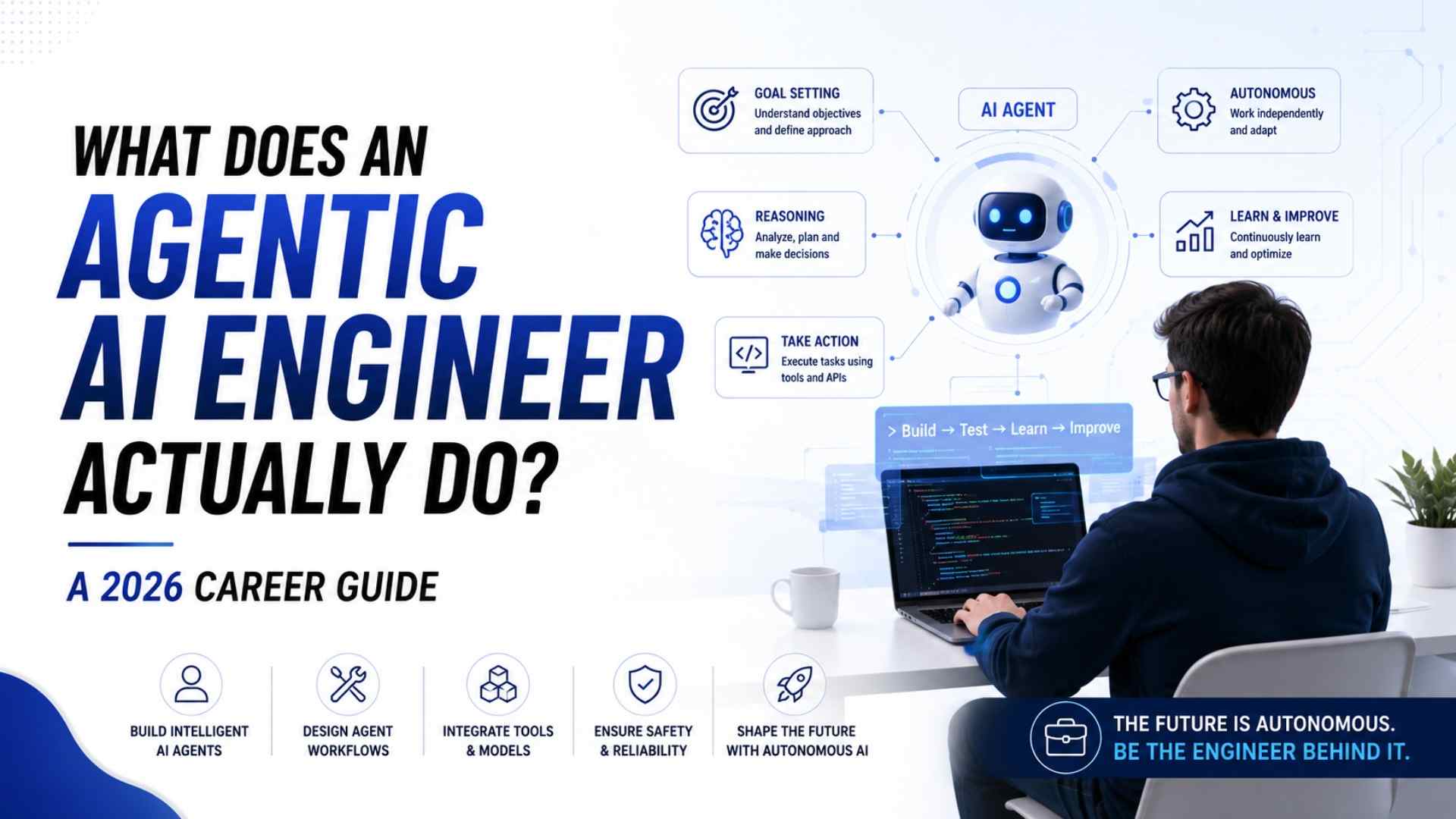
Chatbots answer questions. Agents get things done. That's the simplest way to understand the shift happening across the AI industry right now — and it's why "Agentic AI Engineer" has become one of the fastest-growing job titles in tech.
Where a traditional LLM application waits for a prompt and returns text, an agentic system can break a goal into steps, decide which tools to use, call APIs, check its own work, and loop back when something goes wrong — all with minimal human supervision. Building these systems requires a distinct skill set that sits between machine learning, software engineering, and systems design. Here's what that skill set actually looks like, and how to build it.
From LLM Apps to Autonomous Agents
Most people's first encounter with generative AI was a single prompt-response loop: ask a question, get an answer. Agentic AI moves past this in a few concrete ways:
Planning — breaking a high-level goal into an ordered sequence of sub-tasks
Tool use — calling search engines, databases, code interpreters, or internal APIs to gather information or take action
Memory — retaining context across steps, sessions, or even multiple agents
Multi-agent collaboration — assigning different agents distinct roles (researcher, planner, reviewer) that work together toward one outcome
Self-correction — evaluating intermediate outputs and retrying or re-planning when something fails
This is the architecture behind AI systems that can research a topic, draft a report, check it for errors, and file it — without a human approving every intermediate step.
The Core Toolkit of an Agentic AI Engineer
If you're assessing whether this role fits your background, here's the practical stack employers expect:
Python fluency — NumPy, Pandas, and general scripting remain the foundation
LLM fundamentals — prompt engineering, fine-tuning, and evaluating model outputs
RAG (Retrieval-Augmented Generation) — connecting LLMs to vector databases so they can reason over private or up-to-date data
Orchestration frameworks — LangChain for chaining LLM calls and tools, and multi-agent frameworks such as CrewAI, which coordinates role-based agent teams through "Crews" and event-driven "Flows," and Microsoft's AutoGen for conversational multi-agent workflows
Cloud and deployment — packaging agents with Docker and Kubernetes, serving them via FastAPI, and deploying across AWS, GCP, or Azure
Responsible AI practices — guardrails, permission scoping, and monitoring so autonomous agents can't take unintended actions
Employers are explicitly hiring for this combination — not deep ML research skills alone, and not software engineering alone, but the intersection of both applied to autonomous systems.
In-Demand Roles Built Around Agentic AI
As organizations move from AI pilots to production agents, a distinct set of job titles has emerged:
Agentic AI Engineer
LLM Application Developer
AI Automation Specialist
Multi-Agent Systems Engineer
AI Solutions Architect
Generative AI Developer
These roles span finance, healthcare, retail, and enterprise software — anywhere a company wants an AI system that doesn't just respond, but actually completes a workflow end-to-end.
How to Build These Skills: The Advanced Diploma in Agentic AI Engineering
Self-teaching agentic AI is possible through scattered tutorials and open-source docs, but most learners struggle to move from toy demos to production-grade systems without structured guidance. That's the gap Technovalley's Advanced Diploma in Agentic AI Engineering is built to close.
It's a fast-tracked, 6-month, 280+ hour program following a "Market-First" curriculum — every module is chosen based on what employers are actively hiring for. The program covers:
Python programming, NumPy, Pandas, and search algorithms
Machine learning workflows, regression, classification, and feature engineering
Deep learning with TensorFlow and PyTorch, including CNNs, RNNs, and Transformers
Prompt engineering, LLM fine-tuning, RAG systems, and vector databases
LangChain, agentic AI architecture, and multi-agent orchestration with CrewAI and AutoGen
Cloud deployment, containerization with Docker and Kubernetes, and model serving with FastAPI
AI security and ethics
A full 40% of the program is project-based, culminating in a capstone project where learners solve a real market problem and present it publicly — building a portfolio, not just a transcript. The program also includes resume and LinkedIn coaching, mock interviews, and access to 40+ hiring partners. You can review the complete curriculum and eligibility criteria on the program page.
Is Agentic AI Engineering the Right Move for You?
If you're a software engineer, data professional, or IT specialist watching agent frameworks like LangChain and CrewAI move from research demos into enterprise production, this is one of the clearest near-term opportunities in the AI job market. The organizations hiring for these roles today are still building out their teams — which means there's real room for engineers who can demonstrate hands-on, production-ready agentic AI skills right now.
To find out whether this diploma matches your background and career goals, get in touch with our academic team for personalized guidance, or explore more career insights on our blog.
Technovalley is a NASSCOM-member training and consulting company delivering industry-aligned AI, cybersecurity, and cloud certifications in partnership with global technology leaders including Microsoft, AWS, Oracle, and EC-Council. Learn more about Technovalley.