



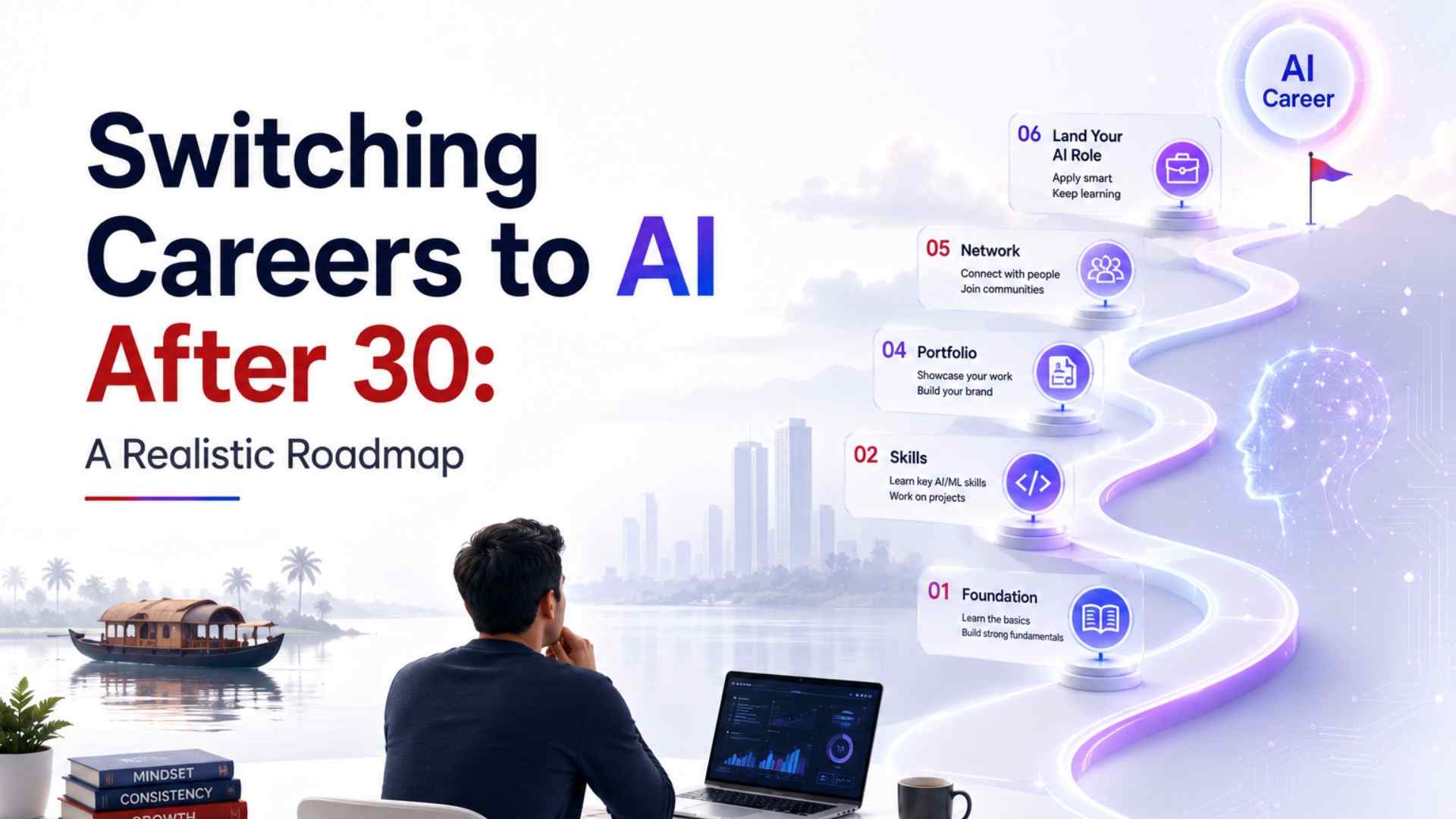
"Is it too late to switch into AI?" is a question we hear constantly from professionals in their 30s and 40s, usually laced with real anxiety about starting over. The honest answer: no, but the path looks different from a fresh graduate's path, and pretending otherwise sets people up for frustration.
What Actually Transfers From Your Existing Career
This is the part most generic career-switch advice skips. Domain expertise is a genuine asset, not dead weight to discard:
Finance professionals moving into AI often have a real edge in fraud detection, risk modelling, and algorithmic trading roles domain fluency that a fresh graduate simply doesn't have
Healthcare professionals bring context that makes them stronger candidates for medical imaging AI, clinical NLP, and healthcare analytics roles than someone with only technical training
Marketing and sales professionals often transition well into AI product roles, customer analytics, and recommendation systems work, where understanding business context matters as much as the modelling itself
Anyone with 8+ years of professional experience brings communication, stakeholder management, and project ownership skills that most fresh graduates are still building — and these are exactly the skills interviewers probe for in the questions covered in Top AI Interview Questions and How to Actually Answer Them in 2026
What Doesn't Transfer, and What to Be Honest About
Domain knowledge doesn't substitute for technical competence you will need to build real, demonstrable skills in Python, statistics, and machine learning, and no amount of prior career seniority shortcuts that requirement. Age bias is also a real, if usually unspoken, factor in some hiring pipelines, and the honest countermeasure isn't ignoring it's making your technical competence and portfolio undeniable, so the conversation shifts to your work rather than your timeline.
A Realistic Sequence for a Career Switcher
Step 1 — Confirm direction cheaply. Before quitting anything or investing serious money, use free resources to confirm which specific AI subfield genuinely interests you, not just "AI" in the abstract.
Step 2 — Choose a program matched to your available time, not your ambition. A working professional switching careers rarely has 500 hours to spare immediately. Technovalley's Certified Data Scientist (160 hours) or Data Analytics Professional (150 hours) programs are specifically built with flexible weekday/weekend delivery for exactly this situation. Our post Which Technovalley AI Program Gives You the Best ROI? breaks this decision down further.
Step 3 — Build a capstone project that explicitly draws on your prior domain. A career switcher from finance building a fraud-detection capstone, or from healthcare building a patient-readmission-risk model, tells a far more compelling interview story than a generic project see How Technovalley's Capstone Projects Actually Work.
Step 4 — Lean on structured placement support rather than navigating alone. Career switchers often underestimate how much a structured process helps counter hiring hesitancy our post From Certification to First Job: Technovalley's Placement Process covers exactly what that support looks like.
FAQs
Is 30, 40, or later genuinely too late to start an AI career? No World Economic Forum data on reskilling consistently shows large-scale workforce transitions into AI-adjacent roles happening across all age groups, driven by the sheer scale of demand outpacing traditional graduate pipelines.
Should I quit my current job before starting a program? Not usually recommended most learners are better served completing a program while employed, using the transition period to build a portfolio before making the jump, unless personal circumstances make that impossible.
Does my prior, unrelated degree matter for AI hiring? Less than most people assume a completed capstone project and demonstrable technical skill increasingly outweigh degree background for applied AI roles.
Ready to plan your realistic transition into AI? Talk to Technovalley's academic team about which program fits your timeline, or browse the full catalogue.