



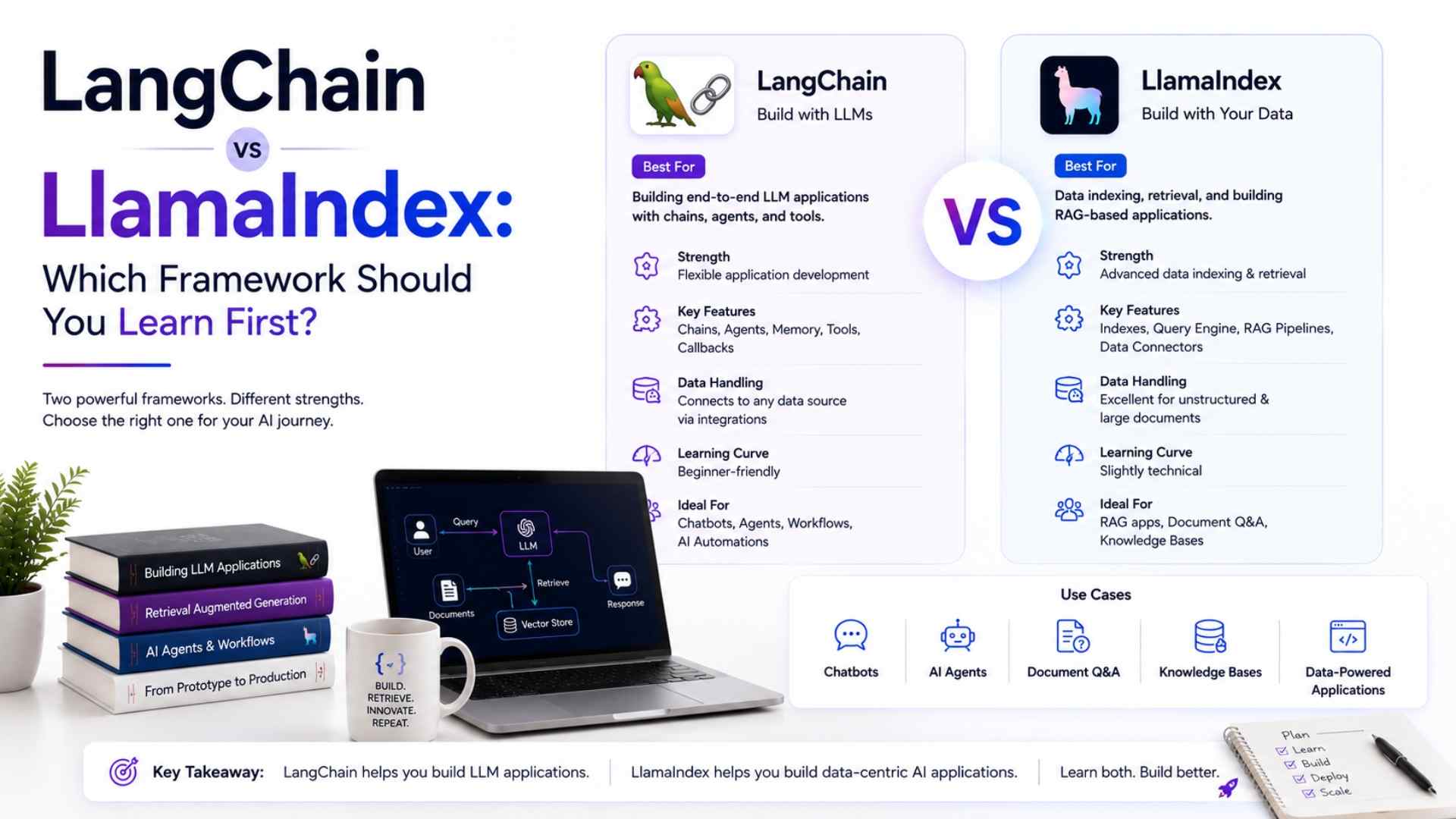
If you've started exploring how to actually build LLM applications rather than just use ChatGPT, you've almost certainly run into both LangChain and LlamaIndex — and the overlap between them genuinely confuses beginners, because both can be used to build RAG systems. Here's the real distinction.
What Each Framework Is Actually Built For
LangChain is a general-purpose framework for building applications around LLMs — chaining together prompts, tools, memory, and multi-step logic. Its strength is flexibility: agents that use external tools, multi-step reasoning workflows, and complex application logic beyond simple question-answering. Our post Prompt Engineering: A Practical Guide Beyond the Basics covers several techniques that LangChain is commonly used to operationalise into actual application code.
LlamaIndex is more specifically focused on one thing and doing it well: connecting LLMs to your own data. It's purpose-built for indexing, structuring, and retrieving from documents, databases, and other data sources — the retrieval half of a RAG system specifically. If your primary need is "let an LLM answer questions from my documents," LlamaIndex is often the more direct, less over-engineered path to that outcome.
A Practical Way to Decide
If your project is primarily about retrieval over a knowledge base — a support chatbot answering from documentation, a research assistant querying a document set — start with LlamaIndex. It's more purpose-built for exactly that job and has a gentler learning curve for that specific use case.
If your project involves multi-step reasoning, tool use, or agents — a system that needs to decide which action to take next, call external APIs, or maintain complex conversation state — LangChain's broader toolkit is the better fit. This overlaps directly with the territory covered in Technovalley's One Year Post Graduate Program in Agentic Artificial Intelligence, which works with both LangChain and LlamaIndex alongside agent-specific frameworks like CrewAI and AutoGen.
In practice, many production systems use both together — LlamaIndex handling the retrieval and indexing layer, LangChain orchestrating the broader application logic around it. Understanding both isn't wasted effort; understanding which one to reach for first for a given problem is the actual skill.
Where to Learn Both Hands-On
Technovalley's Technovalley Certified Generative AI Expert (GAIE) program includes hands-on LangChain work as part of building deployed LLM applications, alongside vector databases and RAG pipelines — see our companion post Vector Databases Explained: The Backbone of Every RAG System for how these pieces fit together. The One Year Post Graduate Program in Generative AI Applications goes deeper still, covering LangChain integration across a full tri-semester curriculum.
FAQs
Do I need to learn both LangChain and LlamaIndex? Not immediately — start with whichever matches your first real project's need, then pick up the other once you hit its limitations. Most working LLM engineers end up knowing both.
Which framework has better long-term career demand? Both are widely used in production systems currently; LangChain's broader scope means it appears in more job postings generally, but LlamaIndex expertise is a real differentiator for retrieval-heavy, document-centric roles specifically.
Is either framework required to build a basic RAG system? No — a RAG system can be built from scratch with a vector database and direct API calls. Both frameworks exist to reduce the boilerplate and complexity of doing that reliably at scale.
Learn to build real LLM applications with the frameworks the industry actually uses. Explore the GAIE program or browse all Generative AI programs.