



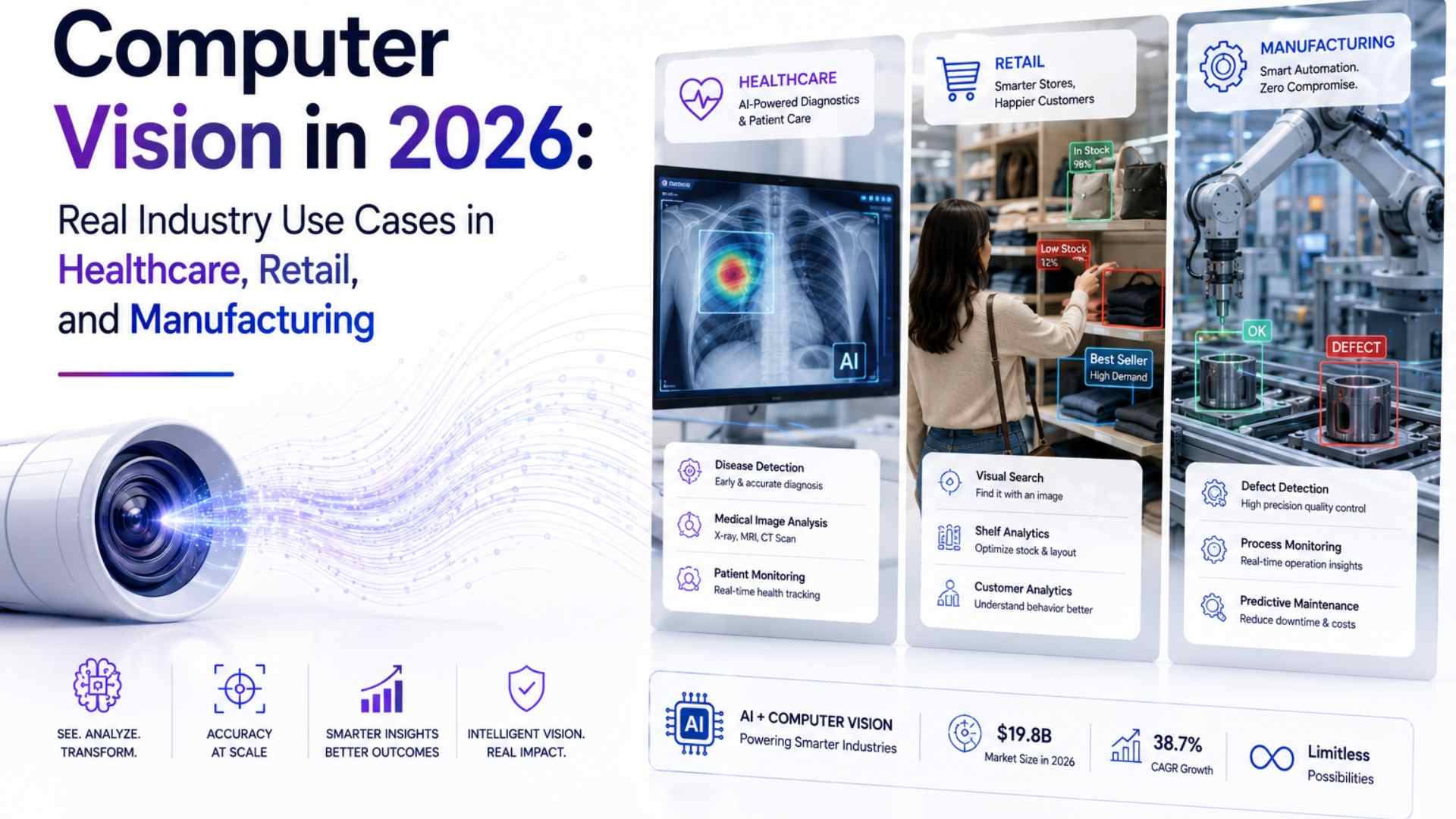
Computer Vision gets less hype than Generative AI right now, but it's quietly running some of the most operationally critical AI systems in production today the kind that don't make headlines because they're just working, reliably, inside real business processes.
Healthcare: Diagnostic Support, Not Replacement
Medical imaging AI analysing X-rays, MRIs, and pathology slides to flag potential abnormalities for radiologist review remains one of the most mature, high-value Computer Vision applications. The framing matters here: these systems are deployed as diagnostic support, prioritising cases and flagging areas of concern for a human specialist, not replacing clinical judgment. This distinction is central to how these systems get regulatory approval and clinical trust, and it's a good example of the explainability requirements covered in our post Explainable AI (XAI): Why 'Black Box' Models Are a Hiring Risk in 2026 — a radiologist needs to understand why a system flagged something, not just that it did.
Retail: Inventory, Loss Prevention, and Store Analytics
Computer Vision now runs a meaningful share of retail's operational backbone — automated inventory tracking through shelf-monitoring cameras, checkout-free store systems, loss prevention through anomaly detection, and foot-traffic analytics that inform store layout decisions. This is a strong entry point for Computer Vision engineers because the business case is unusually easy to quantify (shrinkage reduction, restocking efficiency), which makes these projects easier to get funded and deployed than more experimental AI initiatives.
Manufacturing: Defect Detection and Quality Control
Automated visual inspection — spotting defects on a production line faster and more consistently than manual inspection — is one of the most mature industrial Computer Vision applications, and one where the ROI case is direct and immediate: fewer defective units shipped, less manual inspection labour, faster line speeds. This use case has expanded significantly as camera hardware and edge-computing costs have dropped, making real-time inspection viable even for mid-sized manufacturers, not just large enterprises.
What This Means for Your Learning Path
Computer Vision is rarely learned in isolation from broader ML and Deep Learning fundamentals it's typically one specialisation within a broader AI engineering skill set. Technovalley's Technovalley Certified Artificial Intelligence & Machine Learning Expert program includes Computer Vision as one of its core modules alongside NLP and Deep Learning, giving you the broader context these applications actually sit within. For learners wanting the deepest, most comprehensive coverage — including tools like OpenCV used directly in production systems the One Year Post Graduate Program in Artificial Intelligence Applications covers Computer Vision at full depth across its tri-semester structure.
FAQs
Is Computer Vision a good specialisation compared to Generative AI right now? Both have strong demand, but Computer Vision often has more mature, immediately fundable business use cases (defect detection, inventory), while Generative AI has faster-growing but sometimes less-defined ROI cases a genuinely useful distinction when evaluating job stability vs. growth ceiling.
What tools are standard for Computer Vision work? OpenCV remains foundational, alongside deep learning frameworks like TensorFlow and PyTorch for building the underlying neural network models.
Does Computer Vision require specialised hardware to learn? Not for learning and prototyping cloud-based GPU access (covered in most structured programs) is sufficient; specialised edge hardware only becomes relevant for specific production deployment scenarios like real-time manufacturing inspection.
Build Computer Vision skills within a complete AI foundation. Explore the AI & Machine Learning Expert program or browse the full catalogue.