



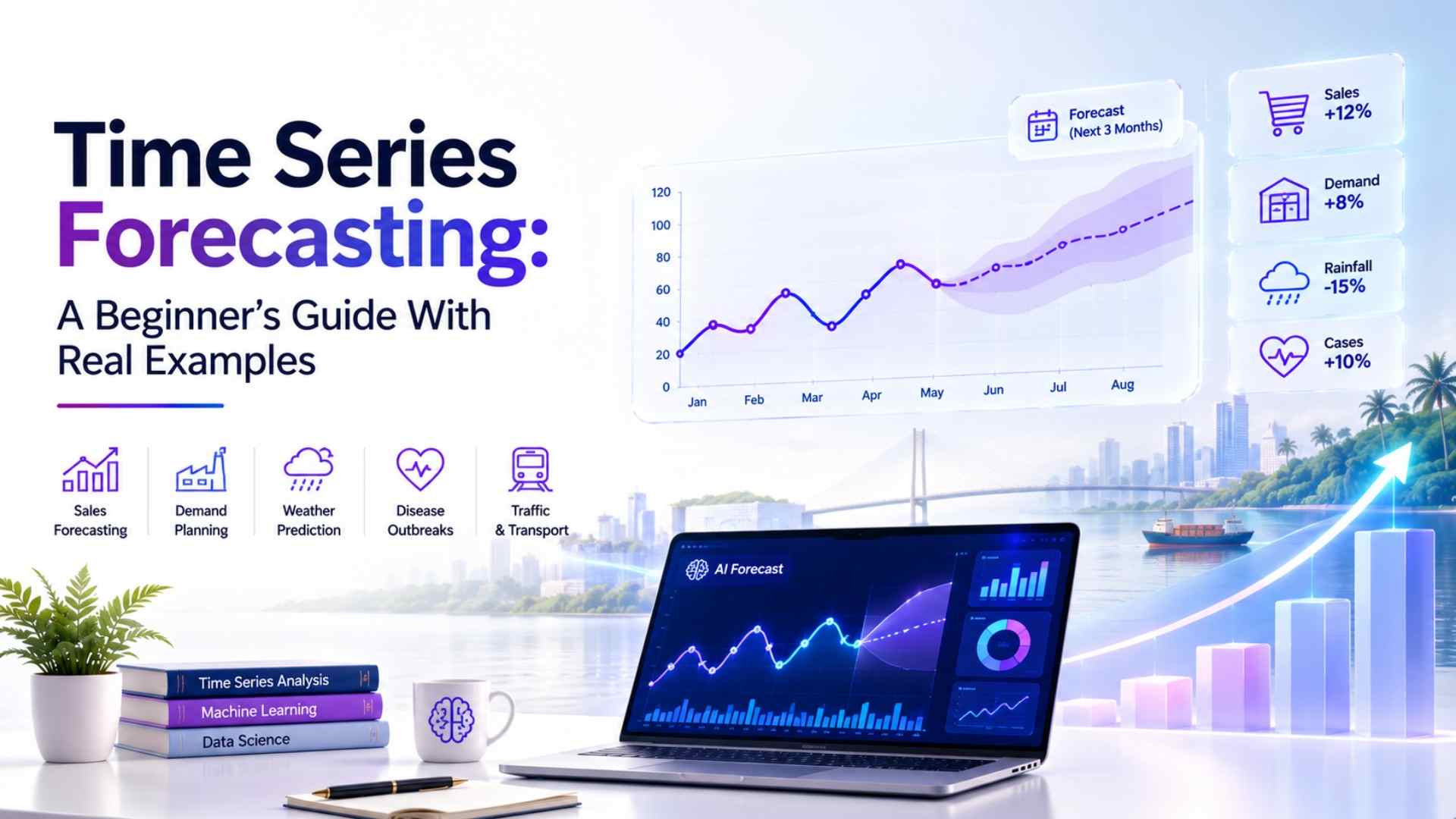
Predicting next quarter's revenue, next week's inventory needs, or tomorrow's server load all share the same underlying challenge: the data has a time dimension that ordinary machine learning approaches often ignore. Time series forecasting is the specific discipline built to handle that.
What Makes Time Series Data Different
Most machine learning assumes your data points are independent of each other — one customer's purchase doesn't directly affect another's. Time series data breaks that assumption entirely: today's sales are influenced by yesterday's, last month's, and the same period last year. Ignoring that temporal structure and treating time series data like any other dataset is one of the most common beginner mistakes, and it consistently produces misleadingly poor forecasts.
Three patterns show up in almost every real time series dataset, and recognising them is the actual foundation of the skill:
Trend — the long-term direction (steadily growing revenue, gradually declining demand for a legacy product)
Seasonality — regular, predictable cycles (retail sales spiking every festive season, electricity demand peaking every summer)
Noise — the irreducible randomness that no model can or should try to perfectly predict
Real Business Examples
Retail demand forecasting — predicting how much inventory to stock ahead of a seasonal spike, balancing the cost of overstocking against the cost of stockouts. This is one of the most commercially valuable and widely deployed time series applications, precisely because the ROI is easy to measure directly in reduced holding costs and fewer missed sales.
Financial forecasting — revenue projection, cash flow forecasting, and demand-driven budgeting all rely on time series methods, often layered with domain-specific business context that a purely statistical model can't capture alone.
Server load and capacity planning — predicting infrastructure demand ahead of time to avoid both overprovisioning (wasted cost) and underprovisioning (performance failures during peak load).
Common Models Worth Knowing
ARIMA (AutoRegressive Integrated Moving Average) — a classical statistical approach, still widely used and often a strong baseline before reaching for more complex methods
Exponential smoothing methods — simple, interpretable, and effective for data with clear trend and seasonality
Prophet (developed by Meta) — designed specifically to be accessible to analysts without deep statistical modelling backgrounds, while handling holidays and seasonality well
LSTM and other deep learning approaches — useful for complex, high-volume time series data, though often overkill for simpler business forecasting problems where a classical model performs just as well with far less complexity
Where to Build This Skill
Time series analysis is a core component of Technovalley's Technovalley Certified Data Scientist and Technovalley Certified Artificial Intelligence & Machine Learning Expert programs, taught alongside the statistical foundations it depends on. For learners specifically focused on business analytics and dashboarding applications of forecasting, the Technovalley Certified Data Analytics Professional program covers predictive modelling including time-series-adjacent forecasting techniques as part of its curriculum.
FAQs
Do I need deep learning to do good time series forecasting? No — classical statistical models like ARIMA and exponential smoothing remain highly effective for most business forecasting problems, and are often easier to explain to stakeholders than a deep learning model.
How much historical data do I need for a reliable forecast? It depends on the seasonality pattern — capturing at least 2–3 full cycles of your relevant seasonal pattern (e.g., 2–3 years of data for annual seasonality) is a reasonable rule of thumb for a reliable model.
Is time series forecasting relevant outside finance and retail? Very much so — healthcare (patient admission forecasting), energy (demand prediction), and logistics (shipment volume forecasting) all rely heavily on the same underlying techniques.
Build practical forecasting skills as part of a complete data science foundation. Explore the Certified Data Scientist program or browse all programs.