



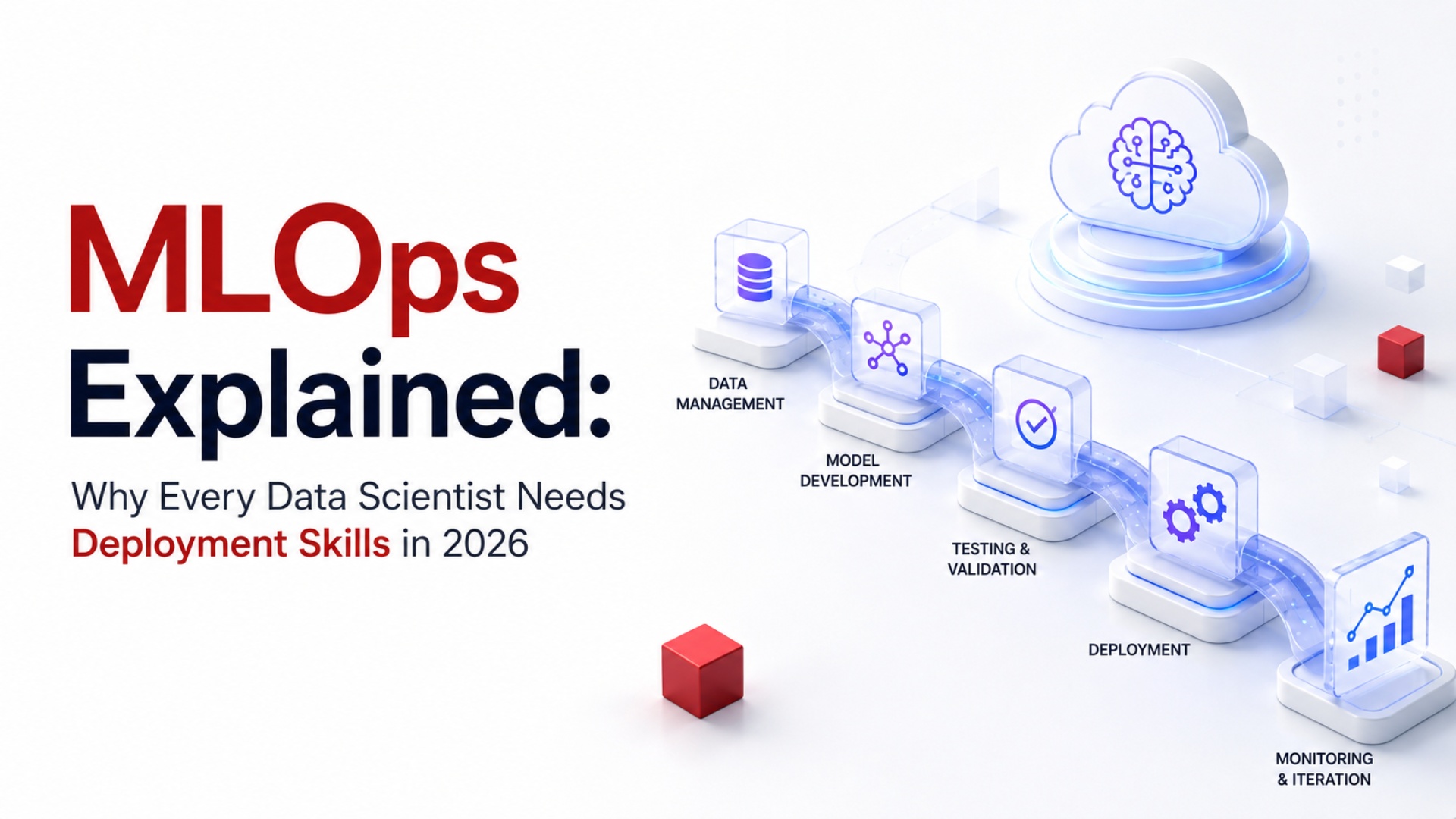
MLOps Explained: Why Every Data Scientist Needs Deployment Skills in 2026
A model that scores 95% accuracy in a Jupyter notebook and never gets deployed is worth nothing to a business. That gap — between a working model and a model that's actually running in production, monitored, and delivering value — is exactly what MLOps exists to close.
What MLOps Actually Means
MLOps (Machine Learning Operations) is the discipline of taking a machine learning model from experimentation to reliable, monitored, scalable production use. It borrows heavily from DevOps principles — automation, continuous integration, monitoring — but applies them to the specific challenges of ML systems: models decay over time as real-world data drifts from training data, they need retraining pipelines, and their outputs need explainability, not just accuracy.
Concretely, MLOps covers:
Automated data pipelines and feature engineering at scale
Model versioning, testing, and deployment automation
Monitoring for model drift and performance degradation
Autoscaling infrastructure to handle production traffic
Explainability and governance for regulated or high-stakes use cases
Why This Has Become Non-Negotiable, Not Optional
For years, "data scientist" and "the person who deploys the model" were often two different roles, or the deployment step was handled ad hoc by whoever was available. That's changed. Google Cloud's own MLOps research has documented this shift clearly — organisations that treat deployment as a first-class part of the ML lifecycle, rather than an afterthought, consistently extract more value from their AI investments than those that don't. That research finding has translated directly into hiring: job postings for "Data Scientist" increasingly list deployment, cloud infrastructure, and monitoring tools as required skills, not nice-to-haves.
What This Means for Your Career Path
If you're a data scientist or ML engineer who's strong on modelling but has never deployed anything past a notebook, this is the single highest-leverage skill gap to close in 2026. It's also one of the clearest differentiators in interviews — being able to speak concretely about model monitoring, retraining triggers, and autoscaling puts you in a different conversation than a candidate who can only discuss algorithm selection.
Technovalley's Oracle Data Science Professional (2025) program is built specifically around this gap — hands-on work with the OCI Data Science Workspaces, ADS SDK, Oracle AutoML, model deployment, autoscaling, and MLOps automation on Oracle Cloud Infrastructure. It assumes foundational ML knowledge, so if you're earlier in your journey, start with the Technovalley Certified Data Scientist program first and treat MLOps specialisation as your next step. Our detailed comparison of Technovalley's three Oracle programs — OCI AI Foundations vs Generative AI Professional vs Oracle Data Science Professional — can help you map out the right sequence.
FAQs
Is MLOps the same as DevOps? Related but distinct. DevOps focuses on software deployment generally; MLOps addresses ML-specific challenges like model drift, retraining pipelines, and data versioning that traditional DevOps tooling wasn't built for.
Do I need to be a software engineer to learn MLOps? Not from scratch, but comfort with cloud infrastructure, containerisation (Docker), and automation concepts helps significantly. These are built into Technovalley's Oracle Data Science Professional curriculum.
What tools are most associated with MLOps right now? On Oracle Cloud specifically: OCI Data Science, ADS SDK, and OCI AI Quick Actions. More broadly across the industry: Docker, Kubernetes, MLflow, and various cloud-native monitoring tools.
Ready to add deployment skills to your data science toolkit? Explore the Oracle Data Science Professional program or talk to our academic team.