



The Fundamental Shift in AI Paradigms
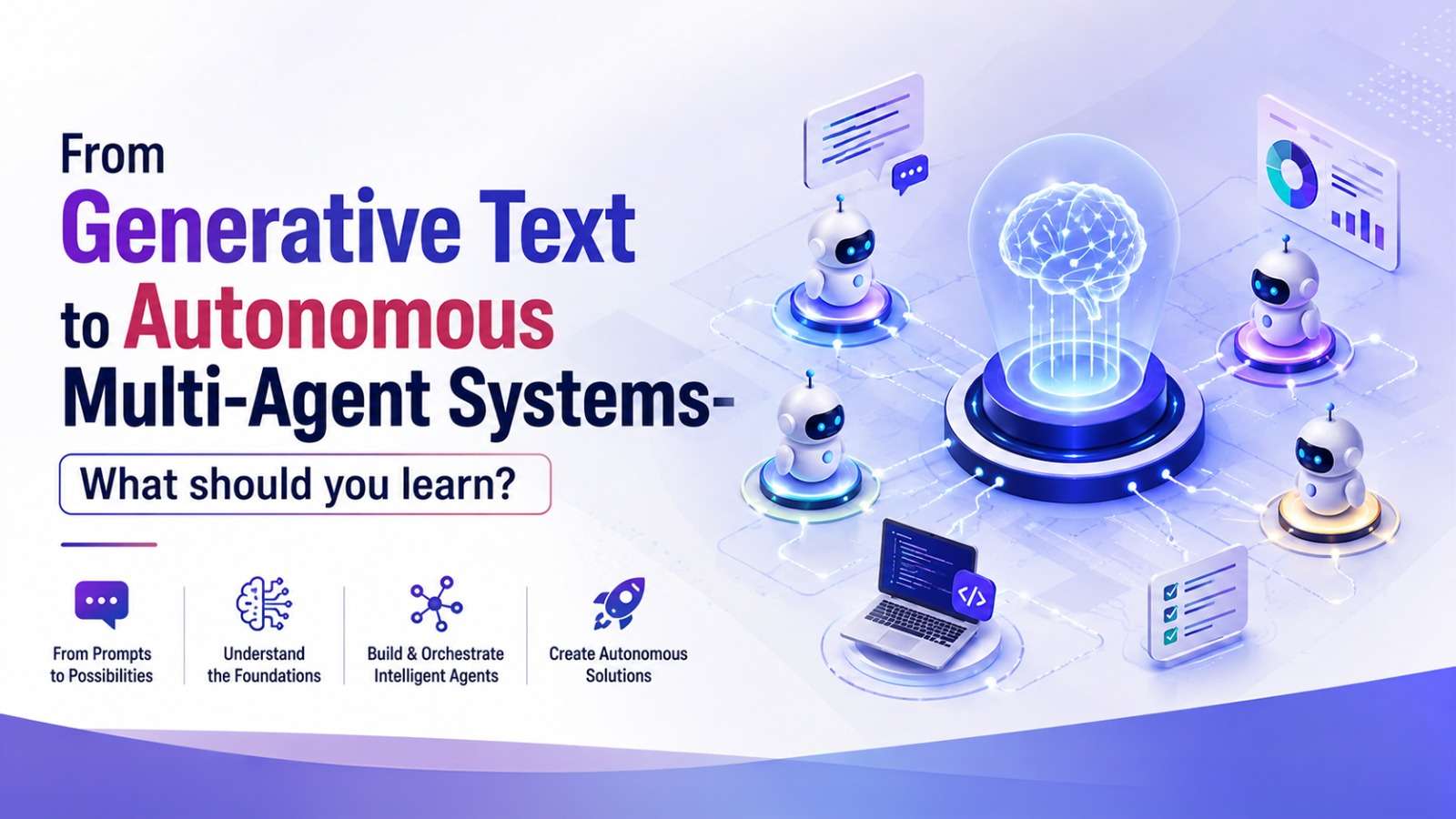
Traditional AI methods are aptly called discriminative and use static labels that focus on finding decision boundaries in between those labels. These are used to answer classification questions like identifying fraud, or prediction of parameters. Generative AI shifts that to a learning methodology and uses parametric probability distributions using something called tokens. This enables the system to draft new content, predict what the next text is instead of static, pre-trained memory used in traditional AI. Now we are in the age of Agentic AI which evolves this further by giving the advantage of a model that has active reasoning capabilities and this agentic engine can do some acts that are aligned with the planning it does to achieve the goal . It operates in an iterative loop that includes the steps of Perception, Reasoning, Planning, Doing the act and Analyzing the action done and for this it uses dynamic tool execution and dual memory that includes short-term scratchpads and also long-term vector stores. Thus agents , especially multiple agents can achieve such complex goals autonomously.
Limitations of Standalone LLMs for enterprise solutions
For an enterprise relying purely on foundation models creates severe operational bottlenecks:
Issue with hallucinations: Models prioritize linguistic fluency over factual accuracy, creating ungrounded responses unacceptable in legal or financial domains.
Retraining Cutoffs for static models: Re-training models continuously to keep up with daily enterprise updates is computationally prohibitive.
Data access limitations: Models lack direct access boundaries to private relational databases, vector indices, and internal document storage.
Retrieval-Augmented Generation (RAG)- Is it needed?
Retrieval-Augmented Generation is the next generation of AI that introduces a runtime retrieval layer and it can be utilized more effectively rather than the old static memory setup, where multiple files can be used to generate content by retrieval from many different resources. In the ingestion phase of RAG, learning how the different enterprise PDFs, web feeds, and SQL records can be parsed into clean text passages and then how the system effectively converts them into numeric vector arrays is essential. During runtime, user queries can trigger top-K cosine similarity searches in vector databases that happen internally. This retrieved context is injected into the prompt, and this allows the LLM to synthesize effective and grounded responses backed by verified sources given for in the first phase.
Scale more capabilities via Multi-Agent Workflows
Complex enterprise automation still needs more effectiveness, autonomy and also requires multi-step decision branching that RAG or earlier AI models cannot handle. Now we can see that even single agents cannot reliably handle too many planning, analysis and tasks that are usually branched and intertwined in corporate setups. Learning how we can utilize multiple agents that can decompose a complex process into different specialized systems with each having its own dedicated roles, distinct system prompts, and restricted API tools is the need of the hour. These are seen to have the ability of drastically increasing system reliability.
For example in our daily lives, if you have ever applied for a job, the ATS systems uses a similar architecture where the automated candidate screening process utilizes various pipelines. First a Resume Parsing Agent ingests raw PDF data. A Skill Profiling Agent analyzes technical depth and experience levels of the resume received and finally a Job Matching Agent queries vector stores to compare candidate embeddings against job requirements. There is another HR Ranking Agent synthesizing these inputs to score candidate fit, flag skill gaps, and generate final interview scorecards. Understanding the workings of these type of agentic work flows is of much demand in the industry
Which are Modern AI Career Specializations that you should aim for?
As production requirements mature, engineering roles are requiring the following job profiles which all splits into distinct specializations:
RAG Developers are a hot category coming under AI specialists who has the task of developing vector database architectures like Pinecone, Qdrant, hybrid search, Cohere reranking, and evaluation frameworks like Ragas.
AI Agent Engineers and Architects- To plan and build autonomous multi-agent networks using frameworks like LangGraph, CrewAI, and AutoGen, mastering tool calling schema design and stateful dual-memory systems.
Gen AI Engineers- is the generic job profile seen in many posting that now includes the above job functions too along with know-how on base LLM integration, prompt engineering, supervised fine-tuning (SFT/PEFT), and local API deployments.
Conclusion- What is the skill that is needed now?
The industry’s transformation from passive text generation to active, autonomous agent networks represents a fundamental evolution in software engineering. Don't get stuck learning the LLM integration only and you need to move past the limitations of standalone language models and grounding architectures. You should be trained in real-time vector retrieval that are the main engines of enterprise AI systems. Mastering tool calling, stateful memory, and multi-agent coordination equips developers to build resilient software that not only generates answers, but executes complex real-world workflows. To secure enterprise roles in today's job market, engineers must advance beyond basic prompt engineering to master hands-on agentic orchestration frameworks using LangGraph, CrewAI, and AutoGen, structured JSON schema design for API tool execution, advanced hybrid RAG architectures with vector databases utilizing Pinecone and ChromaDB. You need to be skillful in stateful dual-memory systems, and AI observability tools like Ragas and LangSmith for production monitoring. These are the main topics that are covered and comprehensively taught in Technovalley industry-focused programs, including the Advanced Diploma in Agentic AI Engineering, the Technovalley Certified Generative AI Expert (GAIE), and the PG-Program in Agentic Artificial Intelligence.