



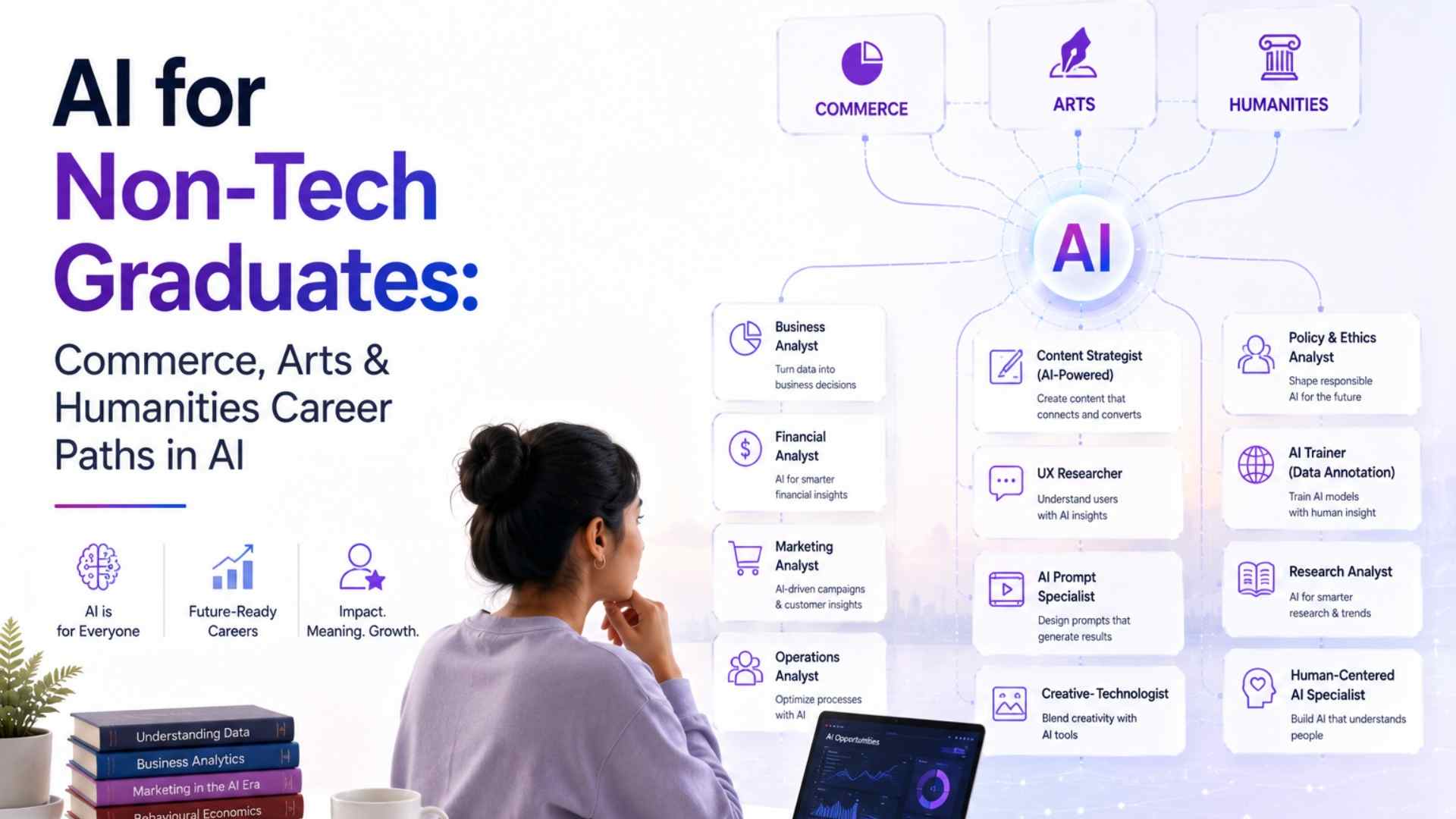
The assumption that an AI career requires an engineering degree keeps a lot of genuinely well-suited people out of the field before they've even tried. It's wrong, and it's worth explaining specifically why — not just as encouragement, but because certain non-technical backgrounds map unusually well onto real AI roles.
Roles That Don't Require a Computer Science Background
AI Governance and Ethics roles lean heavily on backgrounds in law, public policy, and the humanities — the ability to reason carefully about fairness, bias, and unintended consequences is the core skill, not programming. Our post AI Governance Basics: What Every Business Needs to Know Before Deploying AI covers what this work actually involves.
AI Program Management rewards exactly what a commerce or business graduate already has: understanding of ROI, organisational change, and business strategy. Technical depth is not the differentiator in this role — strategic and communication skill is. See our detailed program breakdown: Certified AI Program Manager (C|AIPM).
Data Analytics and BI roles are one of the most accessible entry points for non-technical graduates specifically — the emphasis is on business storytelling and structured thinking (skills a commerce or economics background builds directly), with SQL and visualization tools taught from scratch. See Technovalley Certified Data Analytics Professional.
Prompt Engineering and AI Content roles genuinely reward strong writing and language skill — arguably more than programming ability, since the core task is crafting precise, well-structured natural-language instructions. Our post Prompt Engineering: A Practical Guide Beyond the Basics covers this in depth.
AI-Aware Professional / Responsible AI roles exist specifically for people who understand how AI is used across an organisation without needing to build it — a role that's grown directly out of the compliance and workplace-policy space, which draws naturally from arts, humanities, and business backgrounds.
The Honest Starting Point
For any non-technical graduate, the right first step is Technovalley's AI Essentials (AI|E) program specifically — it requires zero coding background and builds the exact literacy layer these roles are built on. From there, the path diverges based on interest: governance-minded learners move toward C|AIPM, while those drawn to the analytical side can move into Data Analytics Professional without needing a technical degree as a prerequisite.
Why This Gap Exists in the Market
LinkedIn's Jobs on the Rise data has repeatedly shown AI-adjacent roles growing faster than the supply of technically-trained candidates — which has pushed employers to genuinely value strong non-technical hires for roles where communication, governance judgment, and business context matter as much as code. This isn't a consolation path; it's a real, growing part of the AI job market that a purely technical talent pool can't fill on its own.
FAQs
Will I be paid less than a technical AI professional? Compensation varies by role and seniority more than by technical vs non-technical background specifically — a senior AI Program Manager or Governance Lead is typically compensated on par with, or above, mid-level technical roles.
Do I need to eventually learn to code even in a non-technical AI role? Not necessarily, though basic familiarity with how AI systems work (which programs like AI|E teach) makes you meaningfully more effective in any AI-adjacent role, technical or not.
Which non-technical AI role has the fastest hiring growth right now? AI Governance and Program Management roles have shown the sharpest growth as enterprises formalise internal AI policy — a trend our post Which Technovalley AI Program Gives You the Best ROI? touches on when comparing program outcomes.
No engineering degree required — start with AI literacy that's actually built for you. Explore AI|E or talk to our academic team about which path fits your background.